


Truck Accident Attorney New York: #1 for Recovery
Why You Need a Truck Accident Attorney in New York for Your Case
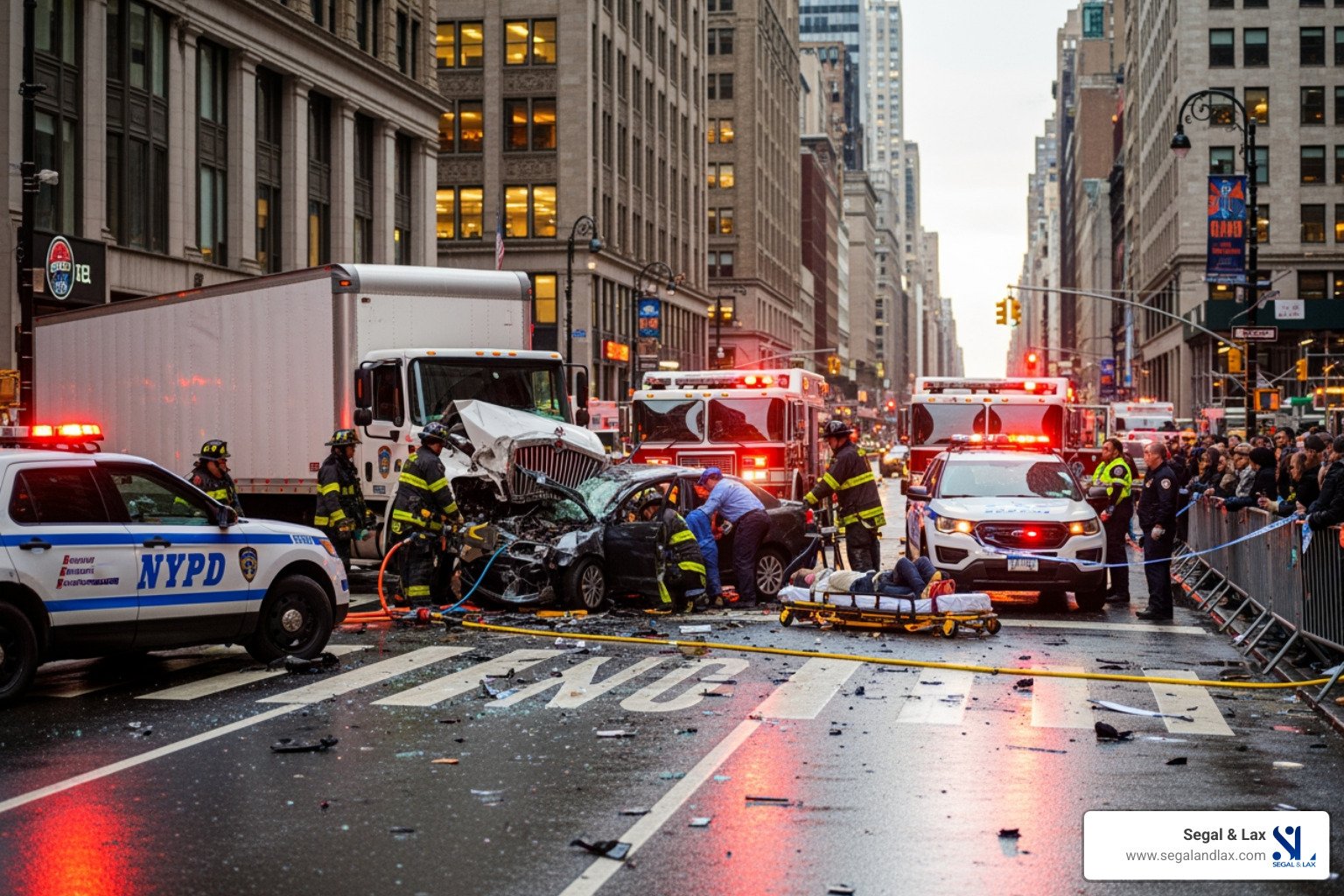
A truck accident attorney New York is your essential advocate after a collision involving a commercial vehicle in the five boroughs. These cases differ dramatically from typical car crashes due to federal regulations, multiple liable parties, and the catastrophic injuries that often result when an 80,000-pound truck collides with a passenger vehicle.
If you’re looking for a truck accident attorney in New York, here’s what you need to know:
- Act within 3 years: New York’s statute of limitations gives you three years to file a personal injury claim (two years for wrongful death)
- Look for specific experience: Your attorney should understand FMCSA regulations, black box data retrieval, and multi-party liability
- Expect a free consultation: Reputable firms work on contingency—no upfront costs, no fees unless you win
- Target these recoverable damages: Medical bills, lost wages, pain and suffering, future earning capacity, and rehabilitation costs
- Know the liable parties: Beyond the driver, you may sue the trucking company, cargo loaders, maintenance contractors, or vehicle manufacturers
The stakes in New York truck accident cases are exceptionally high. According to recent data, 84 people died in truck accidents in New York State in 2020, and truck crashes are twice as likely as car crashes to result in serious injury or death for pedestrians and cyclists. In New York City alone, there were 587 truck accidents in April 2023, highlighting the persistent danger these massive vehicles pose on congested urban streets.
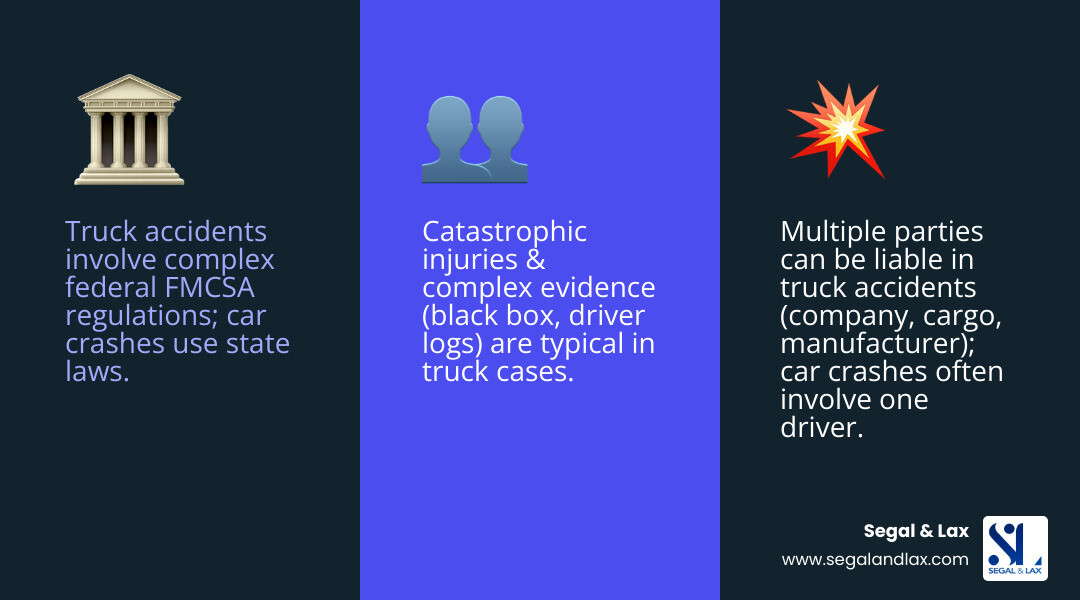
What makes truck accident claims so complex? Unlike a fender-bender between two cars, truck collisions involve a web of federal safety regulations enforced by the Federal Motor Carrier Safety Administration (FMCSA), sophisticated corporate insurance teams that deploy immediately after a crash, and multiple potentially responsible parties—from the driver to the trucking company to the cargo loader. The injuries tend to be devastating: traumatic brain injuries, spinal cord damage, paralysis, and amputations are common when a passenger vehicle is struck by a commercial truck weighing up to 40 times more.
This guide walks you through everything you need to know about pursuing a truck accident claim in New York—from understanding why these cases are different, to identifying who can be held liable, to choosing the right legal representation for your recovery.
I’m Mark Segal, and my team at Segal & Lax has spent decades representing New Yorkers injured in truck accidents across Manhattan, Brooklyn, Queens, the Bronx, and Staten Island. As a truck accident attorney in New York, I’ve seen how quickly insurance companies mobilize to protect their interests, which is why immediate, experienced legal representation is critical to securing the compensation you deserve.
Why You Need a Truck Accident Attorney in New York: The Complexity of Your Case
If you’ve been in a truck accident in New York, you’ve probably already noticed that nothing about the process feels simple. The insurance calls start almost immediately. The injuries are more severe than you expected. And the questions—about who’s responsible, what regulations apply, and how much your case is worth—seem to multiply by the day.
There’s a reason for all this complexity. Truck accidents operate in an entirely different legal universe than car crashes. The vehicles are massive, the regulations are federal, the defendants are multiple, and the insurance companies are aggressive. Understanding these differences isn’t just academic—protecting your right to fair compensation.
The Sheer Scale of Destruction
Let’s start with the most obvious difference: the physics of the collision itself.
A fully loaded commercial truck—the kind you see on the Brooklyn-Queens Expressway or rumbling through the Bronx—can weigh up to 80,000 pounds. Your typical passenger car? Maybe 3,000 to 4,000 pounds. That’s a 20-to-1 weight difference, and when those two vehicles collide, the laws of physics are brutally clear about who suffers.
The U.S. Department of Transportation reports that nearly 97 percent of fatalities in accidents involving larger trucks occur in the smaller vehicle. More than two deaths and 60 injuries happen for every one hundred million miles driven by a semi-truck or big rig. These aren’t just statistics—they represent real people who got into their cars one morning and never made it home.
The injuries we see from truck accidents are often catastrophic. Traumatic brain injuries, spinal cord damage, paralysis, amputations, severe burns—these aren’t the kinds of injuries you bounce back from quickly, if at all. The medical bills pile up. The lost wages multiply. And the emotional toll on families is immeasurable.
If you’ve been in a standard car accident, you can learn more about your options on our Car Accidents page. And if you’ve tragically lost a loved one in a truck collision, we’re deeply sorry for your loss—our Wrongful Death page explains how we can help you seek justice.
The Complex Web of Regulations
Here’s where truck accidents really diverge from car crashes: the regulatory framework.
When you drive your personal vehicle, you need a valid license, insurance, and basic knowledge of traffic laws. When someone drives a commercial truck, they’re operating under a thick manual of federal and state regulations that govern nearly every aspect of their job.
The Federal Motor Carrier Safety Administration (FMCSA) is the federal agency that oversees the trucking industry nationwide, including in New York. Their regulations cover everything from driver qualifications and mandatory medical exams to vehicle maintenance schedules and cargo loading procedures.
One of the most important—and most frequently violated—sets of rules are the Hours-of-Service (HOS) regulations. These dictate how long a truck driver can be behind the wheel before they must take a break. The rules exist because driver fatigue is a leading cause of truck accidents. A drowsy driver controlling 80,000 pounds of steel is a recipe for disaster.
On top of federal rules, New York’s Vehicle and Traffic Law adds state-specific requirements for commercial vehicles, including weight limits, equipment standards, and route restrictions. Investigating whether a truck driver or trucking company violated any of these regulations requires detailed knowledge of both federal and state law—exactly the kind of work a truck accident attorney in New York handles every day.
Identifying Multiple Liable Parties
In most car accidents, figuring out who’s responsible is relatively straightforward. Driver A ran a red light and hit Driver B. But truck accidents? They’re rarely that simple.
A truck accident case can involve a complex web of potentially liable parties, and identifying all of them is crucial to securing full compensation. Beyond the truck driver, you might be able to hold accountable:
The trucking company itself, for negligent hiring practices, inadequate driver training, pressure to meet unrealistic delivery deadlines, or failure to maintain their fleet properly.
Cargo loaders or shipping companies, if the accident resulted from improperly loaded, overweight, or unsecured cargo that shifted during transport.
Vehicle or parts manufacturers, if a defective truck component—faulty brakes, defective tires, steering system failures—contributed to the crash.
Maintenance companies or mechanics, if a third-party contractor failed to properly service the truck or missed critical safety issues during inspections.
Government entities, in cases where poor road design, inadequate maintenance, missing signage, or malfunctioning traffic signals played a role in the accident.
Each of these parties typically has their own insurance policy and their own legal team working to minimize their client’s liability. It’s not unusual for these defendants to point fingers at each other, trying to shift blame away from themselves. Navigating this multi-party litigation requires a strategic approach and a thorough understanding of personal injury law. You can learn more about how we handle various types of claims on our Personal Injury page.
Facing Aggressive Insurance Companies
Here’s something that surprises many truck accident victims: the insurance company isn’t on your side, even when they’re acting friendly.
Trucking companies carry commercial insurance policies with much higher limits than standard auto insurance—often in the millions of dollars. While that might sound like good news for victims, it actually means the insurance company has an enormous financial incentive to pay you as little as possible.
These insurers don’t waste time. It’s common for an adjuster or a representative from the trucking company to contact you within hours or days of the accident, sometimes even while you’re still in the hospital. They might seem sympathetic and helpful, but their tactics are calculated. They might offer a quick, lowball settlement before you even know the full extent of your injuries. They might ask for a recorded statement, hoping you’ll say something they can use against you later. They might present documents for you to sign that unknowingly waive important rights.
Do not speak with insurance adjusters or sign any documents without first consulting a truck accident attorney in New York. Their primary concern is their bottom line, not your recovery. What seems like a generous offer today might be a fraction of what you actually need for medical bills, lost wages, and future care.
Protecting your rights from the outset is crucial. We’ve seen too many good cases damaged by well-meaning victims who tried to handle things on their own in those critical first days. For more insights on avoiding common pitfalls, read our article on the Top 10 Mistakes That Can Destroy Your Personal Injury Case.
The complexity of truck accident cases isn’t meant to discourage you—it’s meant to prepare you. With the right legal representation, these complexities become opportunities to build a stronger case and secure the full compensation you deserve.
A Truck Accident Attorney in New York Explains Damages and Injuries
When a massive commercial truck collides with a passenger vehicle in New York, the consequences are often devastating and life-changing. The physical and emotional toll can be overwhelming, affecting not just the injured person but their entire family. Understanding what injuries are common and what compensation you may be entitled to is an important step in your recovery journey.
Common Injuries from Truck Collisions
The sheer force of an 80,000-pound truck striking a vehicle that weighs less than 4,000 pounds creates a violent impact that the human body simply cannot withstand without serious harm. We see this reality every day in our practice, and it’s heartbreaking.
Traumatic brain injuries (TBI) are frighteningly common in truck accidents. These can range from concussions that may seem minor at first to severe brain damage that permanently alters someone’s ability to think, or even recognize loved ones. A TBI can change your personality, affect your ability to work, and require years of therapy and care.
Spinal cord injuries are another devastating consequence we encounter frequently. Damage to your spinal cord can result in partial or complete paralysis, loss of sensation below the injury site, and lifelong disability. Many of our clients who suffer these injuries face the reality that they may never walk again, requiring extensive home modifications, specialized equipment, and round-the-clock care.
The crushing force of a truck accident can lead to paralysis, whether from spinal cord damage or severe brain injuries. This life-altering condition affects every aspect of daily living and demands significant ongoing medical support and assistance.
In the most severe collisions, amputations become necessary when limbs are too badly damaged to save. The physical and emotional trauma of losing a limb is profound, requiring not only prosthetics and rehabilitation but also psychological support to cope with the permanent change.
Broken bones are almost expected in truck accidents, but these aren’t simple fractures. We’re talking about multiple breaks, compound fractures where bone pierces skin, or bones shattered into many pieces. These injuries often require multiple surgeries, metal plates and screws, and many months of painful physical therapy.
Internal organ damage from chest or abdominal trauma can be life-threatening. Internal bleeding, ruptured organs, and organ failure may not be immediately apparent but require emergency surgery and intensive medical care. These injuries can have long-term health consequences even after initial treatment.
When trucks catch fire after a collision, burn injuries can be horrific and excruciatingly painful. Severe burns often require skin grafts, leave permanent scarring and disfigurement, and involve years of reconstructive surgeries and treatment.
The danger is even more acute for pedestrians and cyclists in New York City’s busy streets. According to data from the city, truck crashes are twice as likely as car crashes to result in serious injury or death for pedestrians and cyclists who have absolutely no protection from the impact. If you or a loved one was injured while walking, our Pedestrian Accidents page provides more information about your rights.
Types of Damages You Can Recover
After suffering such catastrophic injuries, you need and deserve compensation that covers not just your immediate expenses but the full impact this accident will have on your life. In New York, damages fall into two main categories: economic and non-economic.
Economic damages are the tangible, calculable financial losses you’ve suffered. These include medical bills for everything from emergency room treatment to surgeries, hospital stays, medications, medical equipment, and ongoing care. Importantly, this covers both past expenses you’ve already paid and future medical costs you’ll need for the rest of your life.
Lost wages compensate you for the income you’ve missed while recovering from your injuries. But the impact often goes deeper—many truck accident victims can never return to their previous jobs. Loss of earning capacity addresses this reality, compensating you for the difference between what you could have earned throughout your career and what you’ll actually be able to earn given your injuries and limitations.
Rehabilitation costs can be substantial and ongoing. Physical therapy, occupational therapy, speech therapy, psychological counseling, and vocational rehabilitation all fall under this category. For someone with a spinal cord injury or traumatic brain injury, these costs can continue for decades.
Non-economic damages address the human cost—the suffering that can’t be measured on a receipt or invoice but is very real nonetheless. Pain and suffering compensates you for the physical pain and discomfort you’ve endured and will continue to experience. This includes not just the immediate agony after the accident but chronic pain that may never fully go away.
Emotional distress recognizes the psychological trauma of a truck accident. Anxiety, depression, post-traumatic stress disorder (PTSD), fear of driving or being near large trucks—these invisible wounds are just as real as physical injuries and deserve compensation.
Loss of enjoyment of life addresses the activities and pleasures you can no longer participate in. If you were an avid runner who can no longer walk, a musician who lost the use of your hands, or a parent who can no longer play with your children the way you used to, this damage category recognizes that profound loss.
For married individuals, loss of consortium compensates your spouse for the loss of companionship, affection, and intimacy that results from your injuries. Catastrophic injuries affect entire families, and this damage acknowledges that reality.
| Category | What It Covers |
|---|---|
| Economic Damages | Medical bills (past and future), lost wages, loss of earning capacity, rehabilitation costs, property damage, and other quantifiable financial losses |
| Non-Economic Damages | Pain and suffering, emotional distress, loss of enjoyment of life, loss of consortium, and other non-monetary impacts |
The Dangers of New York City’s Streets
New York City’s streets present unique challenges when it comes to truck safety. The congested urban environment, with vehicles, pedestrians, and cyclists all competing for limited space, creates a dangerous mix.
Private garbage trucks are a particular hazard, often operating on tight schedules in the early morning hours. Delivery truck drivers face immense pressure to make their routes quickly, sometimes leading to reckless decisions and cutting corners on safety. When profit margins and delivery deadlines take priority over public safety, innocent New Yorkers pay the price.
The vulnerability of pedestrians and cyclists in this environment cannot be overstated. Without the protection of a vehicle surrounding them, they face catastrophic or fatal injuries even in relatively low-speed collisions with large trucks. Our city’s infrastructure, while improving, still has many intersections and areas where trucks, bikes, and pedestrians come dangerously close together.
If you’ve been injured in an accident involving a bus or other large commercial vehicle, our Bus Accidents page offers additional information about your legal options.
The path forward after a truck accident is never easy, but understanding your injuries and the full scope of compensation available is the first step. A qualified truck accident attorney in New York can help you calculate the true value of your claim and fight to ensure you receive every dollar you deserve for your recovery and future care.