


Cement Truck Accident Brooklyn: 15 Devastating Fatalities
The Unseen Dangers of Brooklyn’s Building Boom
Cement truck accident Brooklyn incidents have become an alarming reality as the borough transforms. If you’re searching for information after an accident, here’s what you need to know:
Common Causes of Cement Truck Accidents in Brooklyn:
- Driver negligence – Fatigue, distraction, or failure to check blind spots
- Company liability – Poor training, inadequate safety procedures, or negligent hiring
- Construction site hazards – Unsafe entry/exit points, especially in industrial areas like Bushwick and Williamsburg
- Vehicle maintenance failures – Brake problems, mirror issues, or mechanical defects
Typical Injuries:
- Traumatic brain injuries
- Spinal cord damage
- Severe fractures
- Internal organ damage
- Wrongful death
Your Legal Rights:
- You can hold multiple parties liable (driver, trucking company, construction company)
- New York law allows three years to file a personal injury claim
- Victims have recovered substantial compensation, including a $2.5 million jury verdict in Kings County Supreme Court
Brooklyn’s construction boom has brought prosperity. It has also brought danger.
On a January morning in 2020, 68-year-old Judith Wieder was crossing New Utrecht Avenue near 49th Street in Borough Park. A cement mixing truck stood stopped at the light. As she walked in front of the massive vehicle, the light changed. The driver moved forward. She was crushed beneath the truck’s left tires.
“I ran out, and they were yelling, ‘Somebody just got hit,'” a witness recalled from another incident on Boerum Street and Bushwick Avenue in Williamsburg.
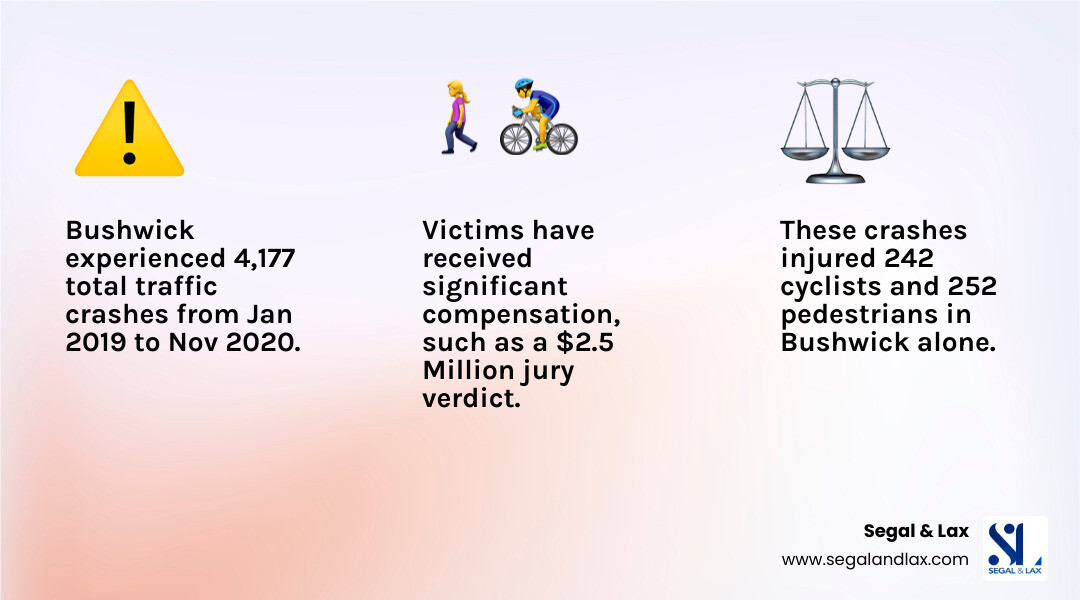
These aren’t isolated tragedies. Between January 2019 and November 2020, Bushwick alone saw 4,177 total crashes, injuring 242 cyclists and 252 pedestrians. Just along an eight-block stretch of Bushwick Avenue between Flushing and Myrtle Avenues, 177 crashes occurred.
As industrial neighborhoods like Williamsburg and Bushwick transform into residential areas, the deadly mix of heavy construction traffic and vulnerable road users intensifies. Cement trucks steer narrow streets designed decades ago. They share space with cyclists, pedestrians, and cars on routes like Atlantic Avenue and the Brooklyn-Queens Expressway.
The human cost is staggering. The legal complexity is real. And for victims crushed by vehicles weighing up to 70,000 pounds, understanding what went wrong and who bears responsibility becomes critical.
Cement truck accident Brooklyn terms made easy:
Unpacking the Causes: Why These Devastating Accidents Happen
Understanding the root causes of a cement truck accident Brooklyn is crucial for victims seeking justice. These incidents are rarely simple, often involving a mix of driver error, company failures, and urban planning issues.
A significant factor is the sheer size and weight of cement trucks. These vehicles have massive blind spots, making it difficult for drivers to see pedestrians, cyclists, or smaller cars, especially when turning or backing up. Due to this design, even a moment of driver distraction can be devastating.
The rapid pace of construction in Brooklyn, particularly in areas like Williamsburg, Bushwick, and Borough Park, puts more cement trucks on crowded, narrow streets not designed for them. This increases accident risks. The primary causes fall into three categories: driver negligence, company liability, and construction site mismanagement.
Driver Negligence and Its Role in a Cement Truck Accident in Brooklyn
Driver negligence is a leading cause of cement truck accident Brooklyn cases. Operating such a large vehicle requires constant vigilance, but factors like fatigue and distraction are common. Long hours in NYC traffic can impair judgment, while distracted driving from cell phone use or other activities poses a significant risk. As we’ve discussed regarding how dangerous is distracted driving?, a moment of inattention can be catastrophic.
Improper turns are another frequent cause. Large trucks need more space to maneuver, especially at busy intersections along Atlantic Avenue or near the Brooklyn-Queens Expressway (BQE). A driver making a wide right turn might not see a cyclist or pedestrian, leading to a “squeeze play” accident. Speeding, disregarding traffic signals, or failing to yield are other dangerous behaviors. A Brooklyn Car Accident Lawyer can investigate these factors.
Construction Site and Company Liability
Beyond the driver, employers and construction site managers often bear responsibility for a cement truck accident Brooklyn. The legal doctrine of respondeat superior holds employers liable for their employees’ negligent actions during employment. If a driver causes an accident on the job, their employer can be held accountable.
A notable Kings County Supreme Court case illustrates this: a jury returned a $2.5 million verdict after a cement truck struck a vehicle while exiting a Brooklyn construction site. The concrete company was found liable.
This case also highlights liability for negligent hiring and poor safety procedures. Companies must ensure drivers are qualified and trained. Construction sites must be managed safely with clear entry/exit points, proper lighting, and flaggers or warning signs to alert the public to truck movements. A lack of these measures can lead to accidents and make the construction company liable. Our page on Construction Accidents offers more context.
The Grim Statistics: Injuries and Fatalities on Brooklyn’s Streets
The consequences of a cement truck accident Brooklyn are often severe, resulting in catastrophic injuries or wrongful death. The immense size and weight of these vehicles mean that victims, particularly pedestrians and cyclists, stand little chance in a collision. The statistics paint a stark picture of the dangers on our borough’s streets, despite initiatives like Vision Zero.
We’ve seen the tragic outcomes in various Brooklyn neighborhoods. The incident on New Utrecht Avenue in Borough Park, where Judith Wieder was killed, is a grim reminder of the vulnerability of pedestrians. Similarly, the fatal accident involving a cyclist on Boerum Street and Bushwick Avenue underscores the risks faced by those on two wheels. Victims often require extensive medical treatment, sometimes at facilities like Woodhull Hospital or Lutheran Medical Center, and face long-term recovery or permanent disability.
Common Injuries from Collisions with Cement Trucks
The types of injuries sustained in collisions with cement trucks are typically severe due to the forces involved. We commonly see:
- Traumatic Brain Injuries (TBIs): From concussions to severe brain damage, these can have lasting cognitive, emotional, and physical effects. Our page on Brain Injury provides more insight.
- Spinal Cord Damage: Injuries to the spinal cord can result in partial or complete paralysis, requiring lifelong care.
- Amputations: Limbs can be crushed or severed, leading to life-altering disabilities.
- Severe Fractures: Bones can be shattered, often requiring multiple surgeries and lengthy rehabilitation.
- Internal Organ Damage: The blunt force trauma can cause internal bleeding and organ rupture, which are often life-threatening.
In cases involving fatalities, families are left struggling with the profound loss of a loved one. These are often considered Wrongful Death cases, where we seek to hold responsible parties accountable for the loss of life. Such catastrophic outcomes highlight the critical need for rigorous safety measures and prompt legal action to secure compensation for victims and their families. More information on severe injuries can be found on our Catastrophic Injury page.
A Look at the Numbers in Brooklyn and NYC
The statistics regarding traffic accidents in Brooklyn and across New York City reveal a troubling trend, particularly concerning vulnerable road users. While the immediate cause of a cement truck accident Brooklyn might be specific, these incidents occur within a broader context of urban road safety challenges.
Consider these alarming figures:
- In 2019, Brooklyn experienced 15 bicycle deaths, an increase from the previous year, highlighting growing risks for cyclists.
- Through November 8, 2020, New York City recorded 204 road fatalities, an increase from 185 over the same period in 2019. While pedestrian deaths were down slightly (81 in 2020 vs. 96 in 2019), cyclist deaths also saw a slight decrease (21 in 2020 vs. 26 in 2019). However, motorcyclist deaths and deaths of drivers/car occupants significantly increased.
- The Bushwick community board alone reported an astonishing 4,177 total crashes between January 2019 and November 2020. These crashes resulted in 242 cyclist injuries (with one fatality) and 252 pedestrian injuries.
- Specific high-risk areas, like the eight-block stretch of Bushwick Avenue between Flushing and Myrtle Avenues, saw 177 crashes in that same period, injuring 12 cyclists, 13 pedestrians, and 44 motorists.
- In 2019, New York City saw at least 122 pedestrian deaths citywide, underscoring the ongoing crisis for those on foot.
These numbers demonstrate that a cement truck accident Brooklyn is not an isolated event but part of a larger pattern of serious traffic incidents impacting our communities. The high volume of pedestrian and cyclist injuries in areas like Bushwick, which are undergoing rapid residential development amidst industrial activity, points to a clear need for improved infrastructure and traffic management. For those affected by incidents on foot, our Pedestrian Accidents page offers valuable resources.
Legal Pathways After a Cement Truck Accident in Brooklyn
After a cement truck accident Brooklyn, the path to recovery is complex. Victims face mounting medical bills, lost income, and emotional distress. Understanding your legal options is the first step toward securing compensation.
Our legal system allows victims to pursue personal injury claims against those responsible by proving negligence—that an at-fault party failed to exercise reasonable care, causing the accident. This requires a thorough investigation of NYPD reports, witness statements, and truck maintenance logs.
This process includes applying legal doctrines like vicarious liability (or respondeat superior), which holds an employer accountable for a driver’s negligence. This is important because trucking companies carry more substantial insurance policies than individual drivers, making it more feasible to recover significant compensation for severe injuries.
We’ve seen these legal pathways succeed, as in a Kings County Supreme Court case where a plaintiff received a $2.5 million jury verdict after a collision with a cement truck exiting a Brooklyn construction site. The case successfully argued the driver was negligent and the company was liable for failing to implement proper safety procedures.
Holding Negligent Parties Accountable
In a cement truck accident Brooklyn case, identifying all liable parties is complex. Our investigation aims to hold every negligent entity accountable.
Potential liable parties include:
- The driver: For actions like distracted driving, speeding, or failing to check blind spots.
- The trucking company: For negligent hiring, inadequate training, poor fleet maintenance, or pressuring drivers to work under unsafe conditions.
- The construction company: If they failed to implement safety protocols for trucks entering or exiting the site, such as providing flaggers or clear signage.
- A maintenance contractor: If faulty truck upkeep caused the accident.
- A parts manufacturer: If a defective part led to a mechanical failure.
Navigating these layers of liability requires specific knowledge of commercial vehicle law. Our Brooklyn Truck Accident Lawyer team is dedicated to uncovering all negligent parties to maximize your potential recovery. A Truck Accident Victim Lawyer can be an invaluable ally.
What Victims Should Know About the Legal Process
If you’re involved in a cement truck accident Brooklyn, the steps you take can significantly impact your claim.
First, seek immediate medical care, even for seemingly minor injuries. Some serious conditions, like internal bleeding or brain injuries, have delayed symptoms. Medical records are crucial evidence linking your injuries to the accident.
Next, document the accident scene if you can. Take photos and videos of the vehicles, surroundings, and your injuries. Get contact information from any witnesses, as this evidence is critical for proving negligence.
Preserve evidence by not speaking with insurance adjusters or signing documents without legal representation. Insurers often try to settle claims quickly for less than their true value.
Be aware of New York’s statute of limitations. For most personal injury claims, you have three years from the accident date to file a lawsuit. However, if a city agency is involved, you may have as little as 90 days to file a notice of claim. Acting quickly is always advisable.
An attorney guides you through these complexities, investigates the accident, and negotiates on your behalf. We work on a contingency fee basis, as explained in our No Fee Accident Lawyer Complete Guide, so you pay nothing unless we recover compensation. Avoiding common pitfalls is also key; our article on Top 10 Mistakes That Can Destroy Your Personal I offers valuable advice.
Forging a Safer Future: Prevention, Regulation, and Urban Planning
Addressing the alarming rate of cement truck accident Brooklyn incidents requires a multi-faceted approach that goes beyond reacting to individual tragedies. It demands proactive measures in safety regulations, city initiatives, and a re-evaluation of urban planning strategies to protect our communities.
The tension between Brooklyn’s booming construction industry and its dense, evolving residential areas is a significant challenge. As industrial zones like Bushwick and Williamsburg gentrify, the influx of residents, cyclists, and pedestrians into areas with heavy commercial vehicle traffic creates dangerous overlaps. City agencies, community groups, and law enforcement all have roles to play in mitigating these risks.
Current Safety Regulations and City Initiatives
New York City has implemented various programs aimed at improving road safety, most notably the Vision Zero Action Plan. This initiative, launched by former Mayor de Blasio, aims to eliminate traffic fatalities and serious injuries. Under Vision Zero, the city has focused on several key areas:
- Enforcement Against Dangerous Driving: The NYPD has been directed to crack down on reckless driving behaviors, including speeding, failure to yield to pedestrians, and parking in bike lanes. This includes increased enforcement in high-risk areas.
- Truck Routing Rules: The city has specific regulations for commercial truck routes, aiming to direct heavy vehicles away from residential streets where possible. However, the practicalities of construction often mean these trucks must access neighborhoods.
- DOT Safety Plans: The Department of Transportation (DOT) is charged with developing and implementing safety plans, including redesigning dangerous intersections and installing protected bike lanes. As a former DOT Commissioner noted in a DOT hearing last October, there’s a particular concern in areas transitioning from industrial to residential where cycling is popular, leading to more collisions with trucks.
- Vehicle Safety Requirements: Efforts are being made to require safety features on commercial vehicles, such as side guards to prevent cyclists and pedestrians from being dragged under trucks, and improved mirror systems to reduce blind spots.
While these initiatives are in place, the statistics show there’s still much work to be done to make our streets truly safe, especially for vulnerable road users. For more on bicycle safety, refer to our Bicycle Accidents page.
The Broader Conversation on Traffic Safety in Brooklyn
The discussion around cement truck accident Brooklyn extends into the broader implications for urban planning and traffic safety. The ongoing change of Brooklyn’s landscape means that old infrastructure must adapt to new realities.
One of the most significant challenges is the issue of industrial zones becoming residential. What were once quiet industrial streets, primarily used by trucks and commercial vehicles, are now busy with apartment buildings, cafes, and parks. This dramatically increases the interaction between heavy machinery and people, creating inherent risks.
There is a pressing need for better infrastructure that prioritizes the safety of all road users. This includes:
- Redesigning dangerous intersections: Intersections with high crash rates, like those along Bushwick Avenue and Atlantic Avenue, need to be re-evaluated for improved sightlines, dedicated turn lanes, and pedestrian refuge islands.
- Expanding protected bike lanes: Creating physical barriers between bike lanes and vehicle traffic can significantly reduce collisions involving cyclists.
- Clearer signage and traffic calming measures: Especially around construction sites and in transitional neighborhoods, better signage and measures to slow down traffic are essential.
Community boards and local advocacy groups play a vital role in pushing for these changes, bringing local concerns to city planners and officials. The tragic incidents involving cement trucks serve as a stark reminder that urban development must be accompanied by thoughtful, safety-focused planning. This is a conversation that resonates across social media, as evidenced by discussions that can be found via links like Share on X (formerly Twitter).
Frequently Asked Questions about Brooklyn Cement Truck Accidents
We understand that after a cement truck accident Brooklyn, you’ll have many questions. Here are answers to some of the most common inquiries we receive:
Who can be held liable for a cement truck accident in Brooklyn?
In a cement truck accident Brooklyn, liability can extend beyond just the driver. Multiple parties might be held responsible, depending on the specific circumstances of the crash. We typically investigate:
- The driver: For direct negligence such as distracted driving, speeding, or violating traffic laws.
- The trucking company: Under the doctrine of respondeat superior, if the driver was acting within the scope of their employment. They may also be liable for negligent hiring, inadequate training, or failure to maintain their vehicles.
- The construction site owner/manager: If unsafe conditions at the construction site, such as poor traffic control or lack of warning signs for trucks entering/exiting, contributed to the accident.
- A maintenance company: If the accident was caused by faulty repairs or inadequate upkeep of the truck.
- A parts manufacturer: In cases where a defective part (e.g., brakes, tires) led to mechanical failure and caused the crash.
Identifying all liable parties is a crucial step in ensuring you receive full compensation. A Brooklyn Personal Injury Lawyer can help conduct this thorough investigation.
What kind of compensation can I receive after being injured?
Victims of a cement truck accident Brooklyn can seek various types of compensation for their losses. These are generally categorized as economic and non-economic damages:
- Medical Expenses: This includes past and future costs for hospital stays, doctor visits, surgeries, medications, rehabilitation, and assistive devices.
- Lost Wages: Compensation for income you’ve lost due to being unable to work after the accident.
- Loss of Earning Capacity: If your injuries prevent you from returning to your previous job or earning the same income in the future, you can claim for this long-term financial impact.
- Pain and Suffering: This covers the physical pain, emotional distress, mental anguish, and loss of enjoyment of life caused by your injuries.
- Property Damage: Costs to repair or replace your vehicle or other personal property damaged in the accident.
- Wrongful Death Damages: In fatal accidents, family members can seek compensation for funeral expenses, loss of financial support, loss of companionship, and other related losses.
The specific amount of compensation depends on the severity of your injuries, the impact on your life, and the specifics of the accident. Our Personal Injury page provides more details on various types of claims.
How long do I have to file a lawsuit after a truck accident in New York?
In New York, the statute of limitations sets a strict deadline for filing personal injury lawsuits. For most personal injury claims arising from a cement truck accident Brooklyn, you generally have three years from the date of the accident to file a lawsuit.
However, there are important exceptions:
- If the claim is against a municipality or city agency (like the City of New York, the DOT, or the MTA), the deadline to file a “Notice of Claim” is much shorter, typically 90 days from the date of the accident. Failure to meet this deadline can result in the forfeiture of your right to sue.
- For wrongful death claims, the statute of limitations is generally two years from the date of the victim’s death.
Given these strict deadlines and the complexities involved, it is crucial to seek legal advice as soon as possible after an accident. Waiting too long can jeopardize your ability to pursue compensation. For immediate assistance and to understand your specific deadlines, please Contact Us without delay.
Demanding Accountability on Brooklyn’s Streets
The rising number of cement truck accident Brooklyn incidents underscores a critical challenge facing our borough: balancing urban development with the safety of its residents. We’ve seen how common causes like driver negligence and company liability contribute to these devastating crashes, resulting in catastrophic injuries and tragic fatalities. The statistics paint a grim picture, particularly for vulnerable road users like pedestrians and cyclists in rapidly changing neighborhoods.
Navigating the aftermath of such an accident can be overwhelming. The legal complexities, from identifying all liable parties to understanding the nuances of New York’s personal injury laws, require experienced guidance. Victims have rights, and we are here to ensure those rights are fiercely protected.
At Segal & Lax, we believe in providing serious, personalized representation to those affected by these life-altering events. We operate on a contingency fee basis, meaning you don’t pay us unless we recover compensation for you. Our commitment is to demand accountability from negligent drivers, trucking companies, and construction entities, helping you secure the justice and financial recovery you deserve.
If you or a loved one has been affected by a truck accident, understanding your rights is the first step toward justice. Learn more about how to steer these complex cases on our Truck Accidents page.