



Queens Car Accident Brain Injury: Don’t Face It Alone!
When a Queens Car Accident Changes Everything: Why You Need a Queens Car Accident Brain Injury Lawyer
If you’re searching for a queens car accident brain injury lawyer, you need to know three critical things right away:
- You have three years from the date of your accident to file a personal injury claim in New York
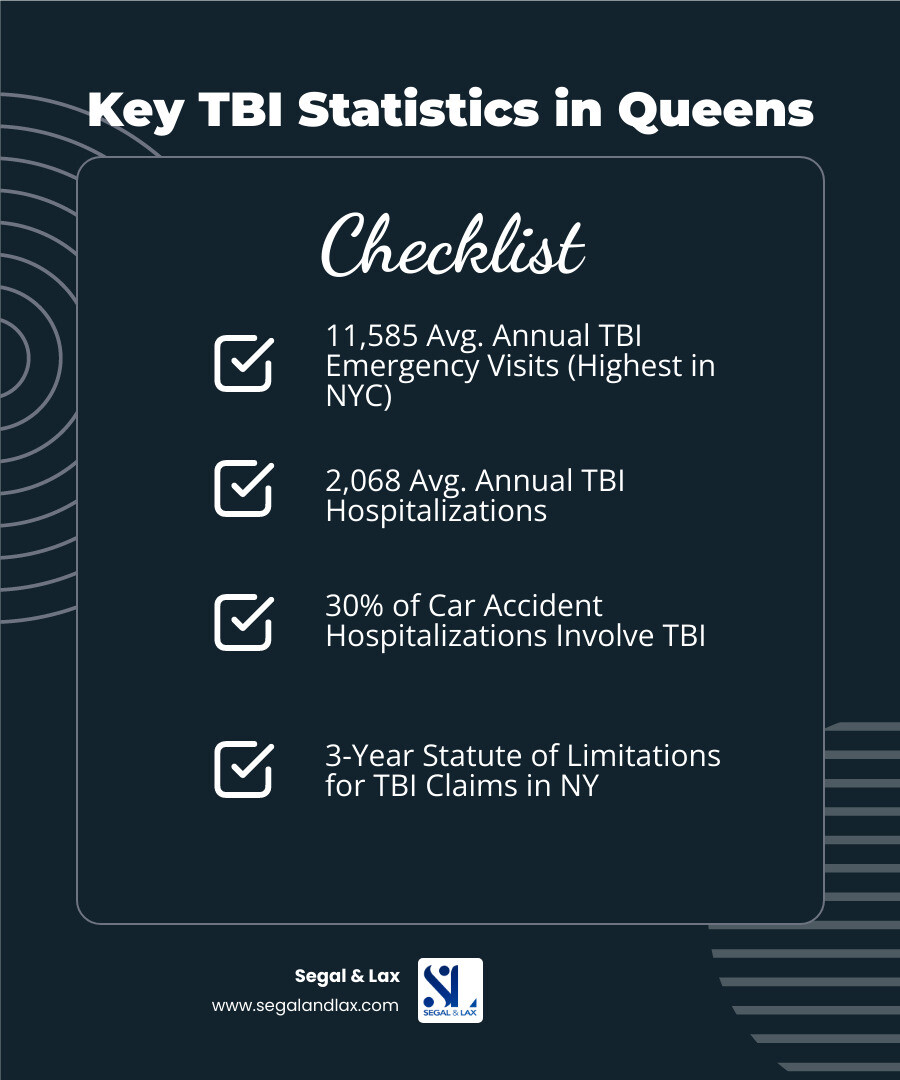
- Queens has the highest number of TBI-related emergency visits of any NYC borough—an average of 11,585 annually
- A lawyer with experience in these cases can help you recover compensation for medical bills, lost wages, pain and suffering, and long-term care costs
Any car accident in Queens can be a traumatic and frightening experience. But when that crash results in a traumatic brain injury (TBI), the consequences can alter your life forever. Between 2012 and 2014, more than 30% of Queens residents hospitalized from car accidents were treated for brain injuries. These aren’t just statistics—they represent real people facing cognitive challenges, emotional changes, and mounting medical bills.
A TBI can disrupt everything from your ability to work to your relationships with loved ones. While you’re dealing with headaches, memory problems, and the overwhelming task of recovery, insurance companies are often working to minimize your claim. The legal process is complex, and the stakes are too high to steer alone.
The financial burden of a brain injury is staggering. Between 2012 and 2014, Queens County crash victims incurred about $70.8 million annually in hospitalization costs alone. Your case might involve not just immediate medical expenses, but years of rehabilitation, therapy, home modifications, and lost earning capacity. Understanding what compensation you’re entitled to—and how to prove it—requires someone who knows both the medicine and the law.
I’m Mark Segal, and our team at Segal & Lax has 75+ years of combined experience handling complex personal injury cases throughout Queens and New York City. As a queens car accident brain injury lawyer, I’ve seen how these injuries impact families, and I’m committed to fighting for the full compensation our clients deserve.
Understanding Traumatic Brain Injuries from Queens Car Accidents: A Guide from a Queens Car Accident Brain Injury Lawyer
A traumatic brain injury happens when a sudden impact or jolt disrupts how your brain normally works. If you’ve been in a car accident in Queens, you might think you need a direct blow to the head to suffer a TBI—but that’s not always the case.
The force of a collision, even at moderate speeds on Queens Boulevard or the Grand Central Parkway, can cause your head to strike the steering wheel, dashboard, windshield, or side window. But here’s what surprises many people: you can suffer a serious brain injury without ever hitting your head on anything.
The rapid acceleration and deceleration that happens during a crash—especially in rear-end collisions that cause whiplash—can make your brain violently shift inside your skull. Think of your brain as floating in fluid inside a hard container. When your vehicle suddenly stops or changes direction, your brain keeps moving, sloshing against the inside of your skull. This internal movement can bruise brain tissue, tear delicate nerve fibers, or cause bleeding.
Even if you don’t black out or lose consciousness, the damage can be significant and life-changing.
Car accidents in Queens can cause several different types of traumatic brain injuries. Concussions are the most common—they happen when a blow to the head or sudden jolt temporarily disrupts normal brain function. Despite being labeled “mild,” concussions should always be taken seriously. They can lead to symptoms that last for months or even become permanent.
Contusions are essentially bruises on your brain tissue, caused by a direct impact to the head. When brain tissue bruises, it swells and bleeds, which can create pressure inside your skull. Diffuse Axonal Injury (DAI) is one of the most severe types of brain injury. It happens when your brain rapidly shifts inside the skull, tearing the long connecting nerve fibers called axons. These injuries often result in long-term brain damage or coma, and some people may not recover over time.
Penetrating injuries occur in the most severe crashes, when an object like shattered glass or vehicle debris pierces through the skull and enters the brain tissue itself.
If you’ve suffered any of these injuries in a Queens car accident, a queens car accident brain injury lawyer can help you understand your legal options and fight for the compensation you need for your recovery.
Symptoms and Long-Term Effects of a TBI
The symptoms of a brain injury don’t always show up right away. Sometimes they appear immediately after the crash, but other times they can be delayed for days or even weeks. This is why it’s so important to see a doctor after any car accident in Queens, even if you feel fine.
Your body is running on adrenaline right after a crash, which can mask serious injuries. By the time the adrenaline wears off, critical time may have passed—time that matters both for your health and for your legal claim.
Physical symptoms are often the first thing people notice. Persistent headaches that won’t go away, dizziness that makes it hard to walk straight, waves of nausea, and overwhelming fatigue are all common. You might find yourself unusually sensitive to light or noise—suddenly the TV volume that never bothered you before feels unbearable. Blurred vision, ringing in the ears, and difficulty speaking clearly can also develop.
Cognitive symptoms can be even more frightening because they affect who you are and how you think. Memory loss might mean you can’t remember the accident itself, or you might struggle to retain new information. Confusion and disorientation can make familiar places feel strange. Many TBI survivors find it hard to concentrate or pay attention, even to things they once enjoyed. Your thinking might feel slow, like you’re moving through fog, and problem-solving or making decisions becomes exhausting.
Emotional symptoms often catch both survivors and their families off guard. Sudden mood swings, irritability over small things, depression, and anxiety can emerge. Some people experience personality changes that strain relationships with loved ones. You might feel unmotivated or have emotional outbursts that seem to come out of nowhere.
The long-term consequences of a traumatic brain injury can reshape your entire life. Chronic pain—especially persistent headaches and neck pain—can become your constant companion. Permanent disability might mean impairments in how you move, think, or process information, affecting everything from your job to basic daily activities.
In severe cases, TBI can lead to a reduced life expectancy. The personality changes that develop can be particularly hard on families who feel like they’ve lost the person they knew. And research shows that TBI increases your risk of developing other serious conditions later in life, including epilepsy, Parkinson’s disease, or Alzheimer’s disease.
The impact ripples outward, affecting not just you but your entire family. They often face the overwhelming task of providing care while managing mounting medical bills and lost income. This is exactly why working with a queens car accident brain injury lawyer who understands these complex injuries can make all the difference in securing the compensation you need for both immediate and long-term care.
Your Legal Rights in Queens: A Queens Car Accident Brain Injury Lawyer Explains Compensation
When a car accident leaves you with a brain injury, you’re facing more than just medical challenges—you’re dealing with a legal system that can feel overwhelming. But here’s what you need to know: you have rights, and understanding them is the first step toward getting the compensation you deserve.
Most TBI claims after car accidents in Queens are built on the foundation of negligence. This isn’t just legal jargon—it’s about proving that someone else’s careless actions caused your injury. We need to establish four critical elements in your case:
First, we show that the other driver had a duty of care to you. On Queens roads, this simply means they should have been driving safely and following traffic laws. Second, we demonstrate they breached that duty—maybe they were texting, speeding down Queens Boulevard, or ran a red light. Third, we establish causation—that their actions directly led to your accident and your brain injury. Finally, we document your damages—all the ways this injury has hurt you physically, emotionally, and financially.
New York has an interesting twist in its legal system that you should understand. The state follows what’s called pure comparative negligence. What this means in plain English: even if you were partially at fault for the accident, you can still recover compensation. Your award just gets reduced by your percentage of fault. If you were 15% responsible, you’d receive 85% of the total compensation. This is exactly why having a queens car accident brain injury lawyer on your side matters so much—we work to minimize any blame assigned to you and maximize your recovery.
What Compensation Can You Recover?
The financial impact of a traumatic brain injury can be staggering, but the law recognizes that you deserve to be made whole. Your compensation falls into two main categories, and both are equally important.
Economic damages are the tangible, calculable costs. Your medical bills start piling up from the moment the ambulance arrives—emergency care, hospital stays, surgeries, medications, and countless doctor visits. Then there are the lost wages from time you couldn’t work, which can stretch from weeks to months or even permanently. If your TBI affects your ability to return to your previous job or limits what you can earn in the future, you can claim that future earning capacity loss.
The costs don’t stop there. Rehabilitation is often extensive and expensive—physical therapy to regain movement, occupational therapy to relearn daily tasks, speech therapy if your communication was affected, and cognitive rehabilitation to help your brain heal. Some TBI survivors need home modifications like ramps or wider doorways to accommodate new physical limitations. Others require assistive devices or the right equipment to manage daily life.
Non-economic damages address the human cost—the parts of your suffering that don’t come with a receipt but are just as real. Pain and suffering compensates you for the physical agony and emotional distress you’ve endured. The emotional distress from a TBI can be profound—anxiety about your future, depression from losing abilities you once had, fear that you’ll never feel like yourself again, or even PTSD from the accident itself.
If your injury has robbed you of activities you loved—playing with your kids, pursuing hobbies, enjoying social gatherings—that’s loss of enjoyment of life, and it matters. When a severe TBI fundamentally changes your relationship with your spouse or partner, that’s loss of consortium, and your loved one may have a claim as well.
The Clock is Ticking: New York’s Statute of Limitations
I wish I could tell you that you have all the time in the world to figure things out, but the reality is more urgent. New York law gives you a three-year time limit for personal injury claims from the date of your accident. That might sound like plenty of time, but three years passes faster than you’d think when you’re focused on recovery.
There’s a critical exception you need to know about: if a government entity was involved—like a New York City bus, a sanitation truck, or any vehicle operated by the MTA or city—you might have as little as 90 days to file a notice of claim. Miss that deadline, and you could lose your right to compensation entirely, regardless of how strong your case is.
Evidence has a way of disappearing. Witnesses move away or forget details. Surveillance footage gets recorded over. Skid marks fade from the pavement. Physical evidence gets lost. The sooner you act, the better we can preserve everything needed to build your strongest case. This isn’t about pressuring you—it’s about protecting your rights when you’re most vulnerable and ensuring you get the justice you deserve.
The Crucial Role of a Queens Car Accident Brain Injury Lawyer
When you’re dealing with the life-altering consequences of a TBI from a car accident, the last thing you need is the added stress of navigating complex legal and insurance systems. This is precisely why it’s so important to hire a dedicated queens car accident brain injury lawyer. We protect your rights and level the playing field against large insurance companies whose primary goal is often to minimize their payouts.
Insurance adjusters are trained negotiators. They might try to offer you a lowball settlement that doesn’t truly cover the full extent of your current and future needs. They may also try to get you to say something that could be used against your claim. Our team manages all communications with the insurance companies, acting as a buffer so you can focus entirely on your recovery. We ensure that your interests are protected at every turn.
How a Queens car accident brain injury lawyer proves your case
Proving negligence and liability in TBI cases requires a thorough and meticulous approach. As your queens car accident brain injury lawyer, we conduct a comprehensive investigation, gathering all available evidence.
Our investigation starts right away. We look at police reports to understand what happened at the scene. We talk to witnesses who saw the accident unfold to get their side of the story. Many modern vehicles also have vehicle data recorders that can provide crucial information about speed, braking, and impact forces. Sometimes, we even work with professionals who can recreate the accident to show exactly how it occurred. We also gather all your medical records from the moment of the crash to show your injury and treatment.
A critical part of our job is establishing the direct link between the car accident and your TBI. This involves demonstrating that the crash caused your injury, rather than a pre-existing condition or another incident. Determining liability in a brain injury lawsuit is crucial for securing compensation. We work to prove that the responsible party’s negligence directly led to your injury.
Overcoming Challenges in TBI Diagnosis and Litigation
Diagnosing and proving TBI in legal cases stemming from car accidents presents unique challenges. Unlike a broken bone, a brain injury can often be an “invisible” injury. Symptoms might be delayed, and standard imaging tests like X-rays often don’t show the damage, especially in mild TBIs. This can lead to defense arguments that the injury is not serious, or even worse, that it’s pre-existing.
This is where the value of hiring an experienced queens car accident brain injury lawyer truly shines. Our firm has extensive experience with TBI cases and understands these diagnostic complexities. We work with a network of medical and financial professionals to build an irrefutable case. We connect you with top medical professionals who can accurately diagnose your TBI and provide important information. We also make sure all aspects of your injury, treatment, and ongoing needs are thoroughly documented. We anticipate and effectively counter claims that your TBI is minor, unrelated to the accident, or pre-existing. We also work with financial professionals to calculate the true, long-term costs of your TBI, including future medical care, lost earning potential, and how it impacts your quality of life.
Queens Car Accident Brain Injury Lawyer: FAQs about TBI Claims
It’s completely normal to have many questions when you’re facing a traumatic brain injury after a car accident. You’re trying to heal, but also wondering about the future. Here are some common questions we hear from clients in Queens, and our straightforward answers.
How much is my Queens car accident TBI case worth?
This is often the first question on people’s minds, and for good reason. You’re dealing with immense challenges, and you need to know what to expect. The truth is, there’s no “average” settlement amount for a TBI case. Each one is deeply personal and unique, just like the individual involved.
The value of your queens car accident brain injury case depends on many important factors. We’ll look closely at the severity of your injury – whether it’s a mild concussion or a more severe, life-altering brain injury. We’ll also account for all of your total medical costs, including past bills and any future treatments you’ll need. Your lost income and future earnings are also a huge part of the picture. If your TBI keeps you from working, or limits your ability to earn what you once did, that’s a significant loss we’ll fight for. We also consider the impact on your quality of life – how your injury affects your daily activities, hobbies, relationships, and overall well-being. Finally, factors like the clarity of fault in the accident and the insurance policy limits of the at-fault driver play a role. Our team at Segal & Lax works tirelessly to assess all these details and pursue the maximum compensation you truly deserve.
Do I have to go to court for my TBI claim?
The idea of going to court can be daunting, especially when you’re focused on recovery. The good news is that most personal injury cases, even complex TBI claims, are resolved through settlement negotiations long before they ever reach a courtroom. We’ll engage in thorough discussions with the at-fault party’s insurance company, always aiming to reach a fair settlement that fully covers your needs. Sometimes, we might use mediation, where a neutral third party helps everyone communicate and find common ground.
While we strive for a settlement, we are always prepared to go to trial if necessary. If the insurance company refuses to offer a fair amount that truly reflects your losses, our seasoned trial attorneys are ready to take your case before a judge and jury. We will fight vigorously for your rights every step of the way.
How long does a TBI lawsuit take in Queens?
The timeline for a TBI lawsuit in Queens can vary quite a bit. There’s no one-size-fits-all answer, as several factors influence how quickly a case moves. For instance, the complexity of your injury plays a big part. More severe and intricate TBIs often require more extensive medical evaluations to fully understand their long-term effects, which can take time.
The negotiation process itself can also affect the duration. Some insurance companies are more willing to settle quickly than others. Court schedules can also cause delays, as the legal system in New York City can be quite busy. During the findy phase, which involves gathering all necessary evidence and professional testimony, we work diligently, but this process can be lengthy to ensure we build the strongest case possible. While some cases might settle in a few months, others can take a year or two, or even longer, especially if they proceed to trial. Rest assured, our team at Segal & Lax will keep you informed and supported throughout your entire legal journey.
Navigating Your Queens TBI Recovery with a Car Accident Brain Injury Lawyer
When you work with a queens car accident brain injury lawyer, you’re not just hiring someone to handle paperwork—you’re partnering with a team that understands the path ahead. From our first conversation to the resolution of your case, we’re with you every step of the way.
The legal process typically begins with an initial consultation, where we sit down and listen to your story. This meeting is completely free, and it’s your chance to understand your rights without any obligation. We’ll discuss what happened, review your injuries, and explain your legal options in plain language.
Once you decide to move forward, we begin our investigation. This is where we roll up our sleeves and gather everything needed to build a strong case—police reports, witness statements, medical records, and any other evidence that supports your claim. We then file your claim, formally notifying the at-fault party and their insurance company that you’re seeking compensation.
The findy phase comes next. This is the formal process of exchanging information with the other side. It might include depositions (recorded interviews under oath), requests for documents, and written questions. It sounds intimidating, but we handle all of this for you, preparing you thoroughly for any participation you need to have.
Throughout this time, we’re actively engaged in negotiation with the insurance company. Most cases reach a resolution here, without ever seeing the inside of a courtroom. If talks hit a roadblock, we might suggest mediation, where a neutral third party helps both sides work toward a fair agreement. But if the insurance company refuses to offer what you truly deserve, we won’t hesitate to take your case to trial. We’re prepared to stand before a judge and jury and fight for your rights.
The Power of Medical Evidence
In any TBI case, medical evidence is the foundation of everything we do. Your injuries might be invisible to the naked eye, but we work to make them crystal clear to insurance companies and juries.
MRIs and CT scans can sometimes reveal physical damage to brain tissue, though not always—especially in mild TBIs. That’s why we also rely heavily on neuropsychological testing. These detailed assessments measure your cognitive functions—memory, attention, problem-solving, and more—providing objective proof of how the injury has affected your thinking and daily life.
We gather every piece of your medical records, from the ambulance ride to your most recent therapy session. And critically, we work with your treating physicians to provide testimony that explains your injuries in terms a jury can understand. When your doctor stands up and describes what’s happened to your brain and how it’s changed your life, it carries tremendous weight.
We also collaborate with several types of medical professionals to paint a complete picture of your injuries and needs. Neurologists help us explain how the brain works and what happens when it’s injured, demonstrating the seriousness of your condition and the challenges you face. Neuropsychologists dive deep into how your TBI affects your thinking, memory, behavior, and personality. Life-care planners look to the future, projecting all the medical and personal care you’ll need for years to come and calculating those costs. And vocational professionals evaluate how your brain injury impacts your ability to work, helping us prove your lost earning capacity.
You’re Not Alone in This Journey
Recovering from a brain injury involves more than legal battles and medical appointments. In Queens, there are local support groups and rehabilitation facilities that can provide emotional support, practical advice, and specific therapies. While we focus on securing your financial recovery, we’re happy to connect you with these resources to support your healing.
At Segal & Lax, we’ve spent over 75 years combined fighting for people just like you across all five boroughs. We know Queens, we know TBI cases, and we know how to win. We work on a contingency fee basis—that “no win, no fee” promise means you pay nothing unless we recover compensation for you. There’s no financial risk in reaching out to us.
You shouldn’t have to face the aftermath of a car accident brain injury alone. We’re here to shoulder the legal burden so you can focus on healing. Get help with your car accident claim by visiting our website or calling us today for a free consultation. Let’s talk about how we can help you move forward.