



Uber & Lyft Accidents in NYC: How to Choose the Right Attorney
Why a Rideshare Accident Lawyer New York is Critical for Your Case
A rideshare accident lawyer New York is essential because these cases involve complex insurance layers, multiple liable parties, and strict legal deadlines that differ from standard car accidents. Research from the University of Chicago and Rice University shows that ridesharing apps like Uber and Lyft led to a 2 to 3 percent increase in traffic fatalities nationwide, making legal representation more important than ever for injured victims.
If you need help right now, here’s what matters most:
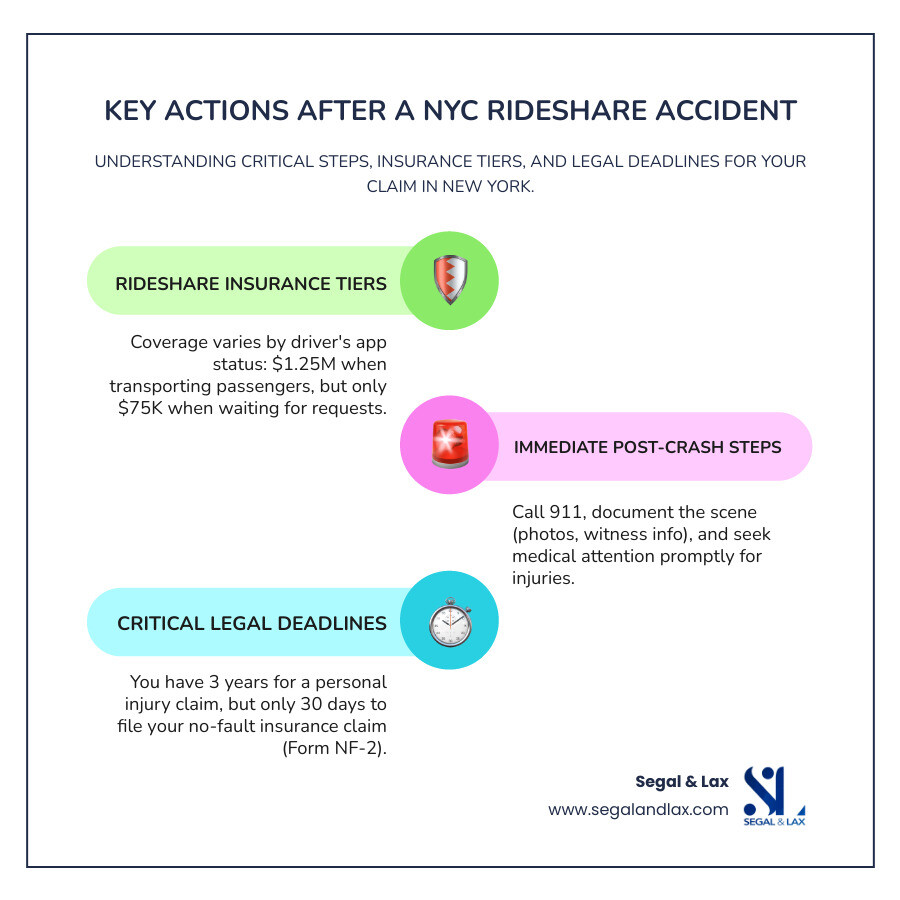
- Insurance coverage depends on driver status: $1.25 million when transporting passengers, but only $75,000 when waiting for requests
- New York’s “serious injury” threshold determines if you can sue for pain and suffering beyond no-fault benefits
- You have 3 years to file a personal injury claim in New York (CPLR §214(5))
- 30 days to file your no-fault insurance claim (Form NF-2)
- Multiple parties may be liable: the driver, rideshare company, other drivers, or even the vehicle owner
For millions of New Yorkers, Uber and Lyft have become essential ways to steer congested streets from the FDR Drive to the Brooklyn-Queens Expressway. But this convenience comes with risk. When you’re injured in a rideshare accident—whether you’re a passenger, pedestrian near Times Square, or another driver on the Queensboro Bridge—you face a legal maze that’s very different from a typical car crash.
Why rideshare accidents are uniquely complicated:
Rideshare companies classify themselves as “software companies” rather than transportation providers. Their drivers are independent contractors, not employees. This creates confusing insurance situations where coverage changes based on whether the driver’s app was on, off, waiting for a request, or actively transporting a passenger.
The Taxi and Limousine Commission (TLC) adds another layer of NYC-specific regulations. New York’s no-fault insurance system requires you to prove a “serious injury” before you can sue for pain and suffering. And insurance companies—whether it’s the driver’s personal policy, the rideshare company’s commercial coverage, or a third party’s insurer—often point fingers at each other to avoid paying.
This isn’t a case you want to handle alone.
Unique Challenges for a Rideshare Accident Lawyer New York
Navigating the five boroughs is an Olympic sport even on a good day. When you add Lyft and Uber vehicles into the mix, the complexity of our streets increases. One of the most significant challenges we face is the scientific research on traffic fatalities which suggests that the introduction of these apps has led to a measurable increase in accidents.
In New York City, these accidents don’t just happen on quiet side streets. They happen while merging onto the FDR Drive, navigating the tight turns of the Queens-Midtown Tunnel, or during the chaotic “gridlock alert” days in Midtown.
The legal challenge begins with the classification of these companies. Because Uber and Lyft view themselves as software platforms, they often try to distance themselves from the actions of their drivers. These drivers are considered independent contractors, which historically allowed companies to deny liability. However, New York has stepped up its oversight. The Taxi and Limousine Commission (TLC) imposes strict regulations on For-Hire Vehicles (FHVs), requiring specific commercial insurance that goes beyond what a standard driver carries.
When we investigate your crash, we aren’t just looking at who hit whom. We are looking at app-trip logs, GPS data, and TLC records to prove exactly what the driver was doing the moment impact occurred.
Determining Liability and Insurance Coverage Tiers
One of the first things we explain to our clients is that the “status” of the driver is the most important factor in your claim. Unlike a car accident involving two private citizens, rideshare insurance works like a tiered cake—and the “flavor” of coverage depends on the app.
Insurance Limits for a Rideshare Accident Lawyer New York
In New York, the law is quite specific about how much coverage must be available. Under New York law on fair settlements, insurers are required to effectuate prompt and equitable settlements, but they often use the driver’s app status to delay the process.
| Driver Status | Liability Coverage | PIP / Uninsured Motorist |
|---|---|---|
| App Offline | Driver’s personal insurance only | Standard personal policy |
| App On / Waiting for Request | Up to $75,000 per person / $150,000 per accident | $50,000 PIP / $25,000 UM |
| Trip Accepted / Passenger in Car | $1.25 million combined single limit | $1.25 million SUM coverage |
When a driver is actively transporting a passenger or en route to a pickup, the policy jumps to a massive $1.25 million. This is intended to cover bodily injury and property damage. However, if the driver is just circling the block near the Barclays Center waiting for a “ping,” the coverage is significantly lower. This is where insurance companies love to argue—they might claim the driver wasn’t “really” working to avoid paying the higher limit.
Liability Beyond the Rideshare Accident Lawyer New York
It isn’t always the Uber or Lyft driver’s fault. Sometimes, a third-party driver blows a red light in Brooklyn and hits your rideshare vehicle. In these cases, we may pursue the other driver’s insurance.
We also see many cases involving pedestrian accidents and cyclists. If a rideshare driver is distracted by their phone while looking for a passenger and strikes a cyclist near Central Park, the $1.25 million policy should apply. Furthermore, if the accident involved a municipal vehicle—like an MTA bus or a DSNY garbage truck—we have to move even faster, as the “Notice of Claim” deadline for government entities is only 90 days.
Recoverable Damages and the Serious Injury Threshold
If you’ve been rushed to Bellevue Hospital or Mount Sinai after a crash, your focus is on healing. Our focus is on making sure your bills are paid. In New York, “No-Fault” insurance (Personal Injury Protection or PIP) covers your initial medical expenses and a portion of lost wages, regardless of who caused the accident.
However, PIP has a limit (usually $50,000). To recover more—especially for “pain and suffering”—you must meet the New York “serious injury” threshold. This is a critical part of any personal injury claim. A “serious injury” includes:
- Fractures (broken bones)
- Significant disfigurement
- Permanent loss of use of a body organ or member
- A non-permanent injury that prevents you from performing your daily tasks for 90 out of the first 180 days following the accident (the 90/180 rule)
We work to recover a full range of damages, including:
- Medical Expenses: From the initial ER visit to long-term physical therapy.
- Lost Wages: Money you missed out on because you couldn’t work.
- Future Earnings: If your injury prevents you from returning to your career.
- Pain and Suffering: Compensation for the physical and emotional toll of the crash.
Immediate Steps to Take After a NYC Rideshare Crash
What you do in the minutes following a crash near Times Square or on the Grand Central Parkway can make or break your case. We know it’s a terrifying experience, but try to follow these steps:
- Call 911: You need a police report. In NYC, the police may not respond to minor “fender benders,” but if there are injuries, they must come. Ensure the officer notes that it was a rideshare vehicle.
- Take Photos: Capture the damage to all vehicles, the license plates, and the surrounding area. If you can, take a screenshot of your Uber or Lyft app showing the active trip.
- Collect Info: Get the names and insurance info of all drivers. Don’t forget to get contact info from any witnesses standing on the sidewalk.
- Seek Medical Care: Even if you feel “fine,” the adrenaline can mask serious injuries like internal bleeding or concussions. Go to the nearest ER or urgent care immediately.
- Don’t Sign Anything: Insurance adjusters might call you within 24 hours with a “quick settlement.” This is almost always a lowball offer. Talk to us first.
Understanding why to hire us becomes clear when you realize how aggressively these billion-dollar companies fight to protect their bottom line.
Frequently Asked Questions about Rideshare Accidents
What is the statute of limitations for a rideshare claim in New York?
For most personal injury claims in New York, you have three years from the date of the accident to file a lawsuit. However, do not wait that long. Evidence disappears, and witnesses forget details. Also, the deadline for No-Fault benefits is much shorter—usually only 30 days to file the initial application.
Can I sue Uber or Lyft if I was a passenger?
Yes, but typically you are filing a claim against their insurance policy rather than suing the corporation directly. Because drivers are independent contractors, the companies are usually shielded from direct lawsuits unless we can prove “negligent hiring” (e.g., they hired a driver with a known dangerous record). Most of the time, your compensation comes from the $1.25 million commercial policy they are required to provide.
How does no-fault insurance work for rideshare passengers?
In a typical NYC rideshare accident, the vehicle’s No-Fault insurance (PIP) should cover your medical bills up to the policy limit. If you were a passenger in an Uber that got hit, that Uber’s insurance is responsible for your immediate medical costs, regardless of whether the Uber driver or the other car was at fault.
Conclusion
At Segal & Lax, we understand that a rideshare accident is more than just a legal case—it’s a disruption to your life. With over 75 years of combined experience, our team provides the serious, personalized representation you need to take on companies like Uber and Lyft.
We serve all five boroughs, from the busy streets of Manhattan to the residential avenues of Staten Island. Our “no win, no fee” promise means you can focus on your recovery at Bellevue or Mount Sinai while we handle the insurance adjusters. If we don’t recover money for you, you don’t pay us a dime.
If you or a loved one has been injured, don’t wait for the insurance company to do the right thing. Contact a Brooklyn Rideshare Accident Lawyer or visit our offices in Manhattan today for a free consultation. Let us help you steer the road to recovery.