


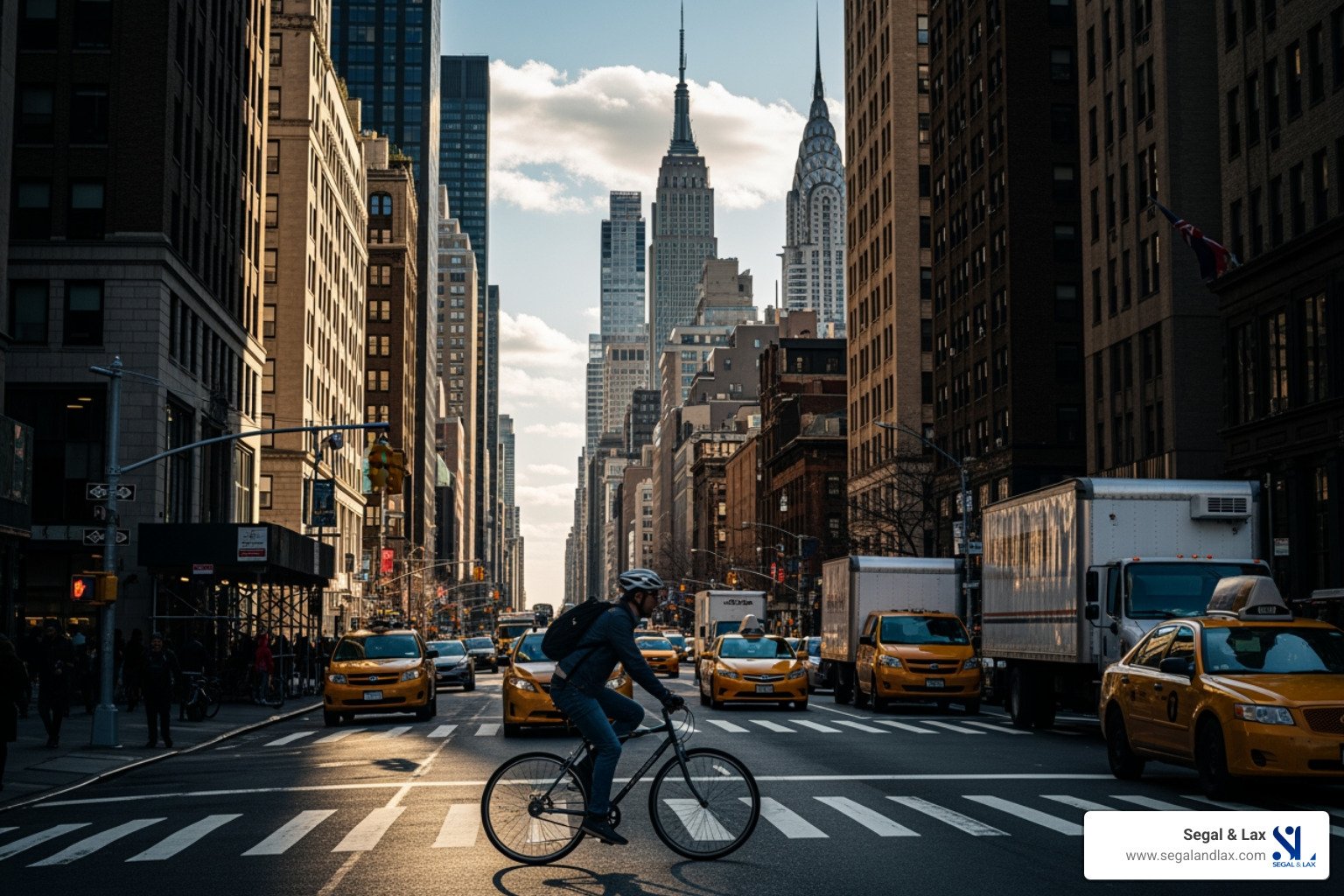
Bicycle Accident Manhattan 2023: Protect Your Rights
The Growing Challenge of Bicycle Safety in Manhattan
Bicycle accident Manhattan incidents are a growing concern, with serious consequences for riders. In 2023, Manhattan recorded 1,479 bicyclist injuries and 7 fatalities from crashes. This rise in accidents comes as cycling becomes a more popular, sustainable, and affordable way to steer the borough’s congested streets. However, heavy traffic, unpredictable drivers, and infrastructure hazards create a dangerous environment for even the most cautious cyclists.
If you’ve been injured in a cycling collision, you have the right to pursue compensation for medical bills, lost wages, and pain and suffering. It’s important to know that under New York’s comparative negligence law, you may still have a case even if you were partially at fault.
Key Facts About Manhattan Bicycle Accidents:
- 1,666 total crashes involving bicycles and motor vehicles in 2023
- Driver inattention and failure to yield are leading causes
- You have 3 years from the date of injury to file a lawsuit
- Comparative negligence means you can still recover compensation even if partially at fault
- Immediate steps: seek medical care, file a police report, document the scene
I’m Mark Segal, and with decades of experience in New York personal injury law, I’ve represented many cyclists injured in bicycle accident Manhattan incidents. This guide will help you understand the current state of cycling safety, identify common risks, and know what steps to take if you’re involved in a crash.
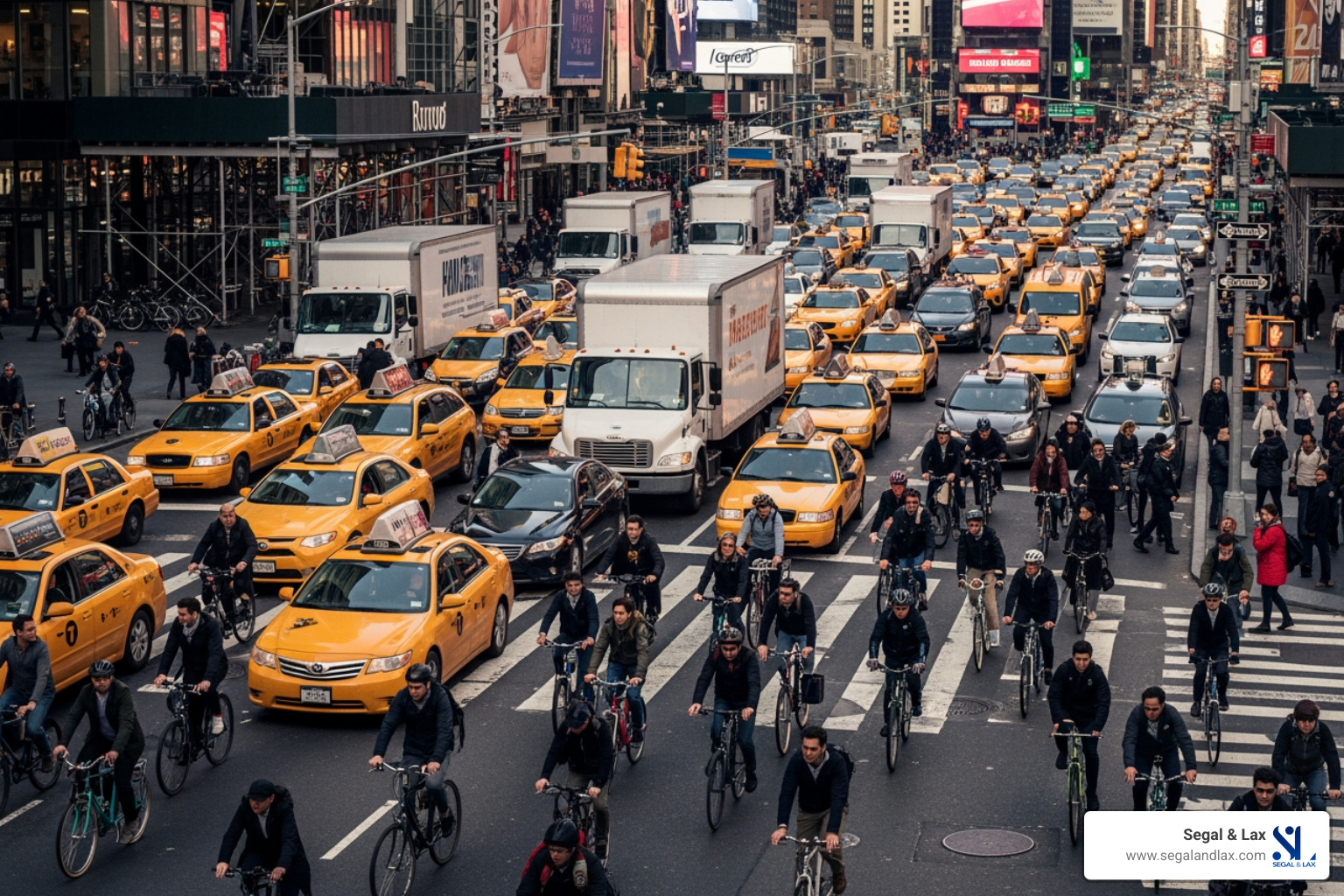
The State of Cycling Safety: A Look at Bicycle Accident Manhattan Statistics
If you ride a bike in Manhattan, you know the risks. The official crash data confirms this feeling, revealing a troubling picture of cycling safety on our streets.
In 2023, Manhattan saw 1,479 bicyclist injuries and 7 fatalities. While these numbers fluctuate annually—for instance, 2022 had 1,394 injuries and 3 fatalities—the overall trend shows that injuries remain consistently high, often exceeding 1,200 per year. The jump in fatalities from 3 in 2022 to 7 in 2023 is particularly heartbreaking and shows how far the city’s Vision Zero initiative has to go.
The data makes one thing clear: the vast majority of serious bicycle accident Manhattan incidents involve motor vehicles. In 2023, there were 1,666 such crashes. When a multi-ton vehicle collides with a bicycle, the results are often devastating for the cyclist.
Crashes involving only bicycles are also a concern, rising from 168 incidents in 2022 to 206 in 2023. This may reflect the growing number of faster e-bikes and e-scooters on the streets. Still, collisions with cars, trucks, and buses remain the single greatest threat to cyclists.
You can explore the raw numbers yourself through the Official NYC crash data and find more analysis in the NYC DOT’s 2023 Bicycle Crash Report.
Understanding the Data
Where do these numbers come from? When a bicycle accident Manhattan is reported to the NYPD, officers complete a police accident report (an MV-104AN form). This is required for any collision involving injury, death, or significant property damage. This data is crucial for the city’s Vision Zero initiative, which aims to eliminate all traffic fatalities.
Accurate data helps the NYC Department of Transportation (DOT) make informed decisions about where to build protected bike lanes, redesign intersections, and focus enforcement efforts. This is why reporting every crash is so important. When incidents go unreported, dangerous areas may appear safer than they are, preventing necessary safety improvements. Filing a police report not only protects your legal rights but also contributes to making the streets safer for all cyclists.
Common Causes and High-Risk Areas for Cyclists
Manhattan’s crowded environment presents a unique set of challenges for cyclists. The causes of a bicycle accident Manhattan often involve a combination of motorist behavior, infrastructure issues, and the actions of others.
Analyzing the Causes of a Bicycle Accident in Manhattan
Our experience shows that many bicycle accidents stem from a few recurring issues:
- Motorist Behavior: This is the most significant factor in serious bicycle accidents.
- Driver Inattention/Distraction: In our city, drivers are often distracted by mobile devices or GPS systems. Driver inattention is consistently a leading contributing factor in citywide collisions. A moment of distraction can have devastating consequences for a cyclist.
- Failure to Yield Right-of-Way: At intersections, drivers often fail to see or yield to cyclists, leading to collisions when turning or proceeding through lights.
- Aggressive Driving/Unsafe Speed: Abrupt lane changes, tailgating, and speeding put cyclists in extreme danger. Mayor Eric Adams has frequently cited speed as a key factor in fatal crashes.
- “Dooring” Incidents: This occurs when a driver or passenger opens a car door into an oncoming cyclist’s path, a sudden and dangerous hazard.
- Unsafe Lane Changes: Drivers often fail to give cyclists adequate space, leading to sideswipes or forcing riders into dangerous situations.
- E-bike and E-scooter Hazards: The rise of electric two-wheelers introduces new risks. Their higher speeds can be dangerous, and pursuing compensation from a negligent e-cyclist can be difficult as they typically lack auto insurance.
- Pedestrian Actions: Jaywalking or stepping into bike lanes unexpectedly can cause collisions with cyclists.
- Cyclist Challenges: Inexperienced riders, lack of safety gear, or failing to follow traffic laws can increase risk. Poor road conditions like potholes can also force cyclists to swerve unexpectedly.
Dangerous Intersections and Neighborhoods
While a bicycle accident Manhattan can happen anywhere, certain areas are known high-risk zones:
- High-Traffic Zones: Areas like Midtown, the Financial District, and SoHo have a higher incidence of collisions due to dense vehicle and pedestrian traffic.
- Chinatown Intersections: The area around Canal Street and Bowery has been the site of multiple tragic accidents, including one where a car exiting the Manhattan Bridge struck and killed a cyclist and a pedestrian.
- Upper West Side: The intersection of Amsterdam Avenue and West 99th Street was the scene of a fatal hit-and-run involving two cyclists, highlighting the dangers even in residential areas.
- Areas Near Bridge Exits: Intersections near bridge exits, such as the Manhattan Bridge or Queensboro Bridge, are often perilous as drivers merge, turn, and adjust to city speeds.
Your Rights and What to Do After a Crash
Being involved in a bicycle accident Manhattan is a traumatic experience. The actions you take immediately after a crash can significantly impact your health and your ability to pursue legal action.
Steps to Take Immediately Following an Accident
We always advise our clients to take these crucial first steps:
- Move to a safe location if possible: Your immediate safety is the top priority. If you can, move yourself and your bicycle out of traffic to avoid further injury.
- Call 911 to report the accident and request medical assistance: A police report is vital for documenting the incident. Seek medical attention even if you feel fine, as some serious injuries have delayed symptoms.
- Exchange information with all parties: Get the driver’s name, contact information, insurance details, and license plate number.
- Document the scene with photos/videos: Use your phone to photograph vehicle positions, damage to your bike, road conditions, traffic signs, and any visible injuries.
- Get contact information from any witnesses: Eyewitness accounts are incredibly valuable, especially in a hit-and-run or if the driver disputes what happened.
Do not admit fault or sign any documents at the scene other than what is required by law enforcement.
Understanding Your Legal Options for a Bicycle Accident in Manhattan
After ensuring your safety, it’s critical to understand your legal rights. If you’ve been injured, you can pursue compensation for the damages you’ve suffered.
- Right to Compensation: As an injured cyclist, you can seek recovery for:
- Medical bills (current and future)
- Lost wages (current and future)
- Pain and suffering (physical and emotional)
- Property damage (your bicycle and other items)
- Loss of enjoyment of life
- New York’s Comparative Negligence Rule: This is a key aspect of New York law. It means you can still recover compensation even if you were partially at fault for the accident. Your financial recovery is simply reduced by your percentage of fault. For example, if you are found 20% at fault for an accident with $100,000 in damages, you could still recover $80,000. Insurance companies often try to blame cyclists to reduce payouts, so understanding this rule is crucial.
- Statute of Limitations: In New York, you generally have three years from the date of the injury to file a personal injury lawsuit. For wrongful death claims, the period is typically two years. Missing these deadlines can prevent you from ever seeking compensation, so it is essential to act promptly.
NYC’s Response: Safety Measures and Enforcement
New York City is continually working to make its streets safer for the growing number of cyclists and prevent bicycle accident Manhattan incidents. These efforts involve infrastructure improvements, public policy, and law enforcement.
![Image of a newly installed protected bike lane in a Manhattan neighborhood – bicycle accident Manhattan]
Current and Proposed Safety Infrastructure
The NYC Department of Transportation (NYC DOT) leads many of the city’s safety initiatives under the Vision Zero program, which launched in 2014 with the goal of eliminating all traffic deaths and serious injuries.
- Expansion of Bike Lane Network: A key part of Vision Zero is building more protected bike lanes, which use physical barriers to separate cyclists from vehicle traffic, significantly reducing the risk of collisions.
- Intersection Redesigns: High-crash intersections are often redesigned with traffic calming measures to improve visibility and create clearer, safer paths for drivers, cyclists, and pedestrians.
- Public Awareness Campaigns: The NYC DOT runs campaigns to educate all road users on how to share the road safely and responsibly.
- Debates on Speed Limits for E-bikes: The popularity of e-bikes and e-scooters has sparked discussions about new regulations, including potential speed limits, to address the risks associated with their higher speeds.
The Role of City Officials and Law Enforcement
City leaders and the NYPD also play a major role in street safety. The NYPD is responsible for enforcing traffic laws and creating police reports (MV-104 reports) after accidents, which provide crucial data for safety analysis.
There is ongoing debate about how the NYPD enforces traffic laws. While Vision Zero focuses on dangerous driving, some cycling advocates feel that cyclists are unfairly targeted for minor infractions. Mayor Eric Adams has repeatedly stated his commitment to street safety, often calling for an end to reckless driving, but his administration’s approach of enforcing rules for both drivers and cyclists has drawn mixed reactions.
Advocacy groups argue that enforcement should focus primarily on the dangerous driving behaviors that cause the most harm. Finding the right balance for effective enforcement that truly makes streets safer for everyone remains an ongoing challenge for the city.
Frequently Asked Questions about Bicycle Accidents in Manhattan
After a bicycle accident Manhattan, you likely have many questions. With decades of experience helping injured cyclists, we’ve compiled answers to the most common ones.
What if the driver who hit me fled the scene?
A hit-and-run accident is a frightening experience, but you may still have options for compensation, even if the driver is never found.
If you have an auto insurance policy, it may include uninsured motorist coverage that extends to you while cycling. New York also has the Motor Vehicle Accident Indemnification Corporation (MVAIC), a state fund designed to help victims of accidents with uninsured or unidentified drivers.
The most critical step is to file a police report immediately. An official report is necessary to start an investigation and is required to make a claim through MVAIC or your own insurance. Call 911 from the scene to protect your rights.
Can I still receive compensation if I was partially at fault for the accident?
Yes. New York follows a pure comparative negligence rule. This means you can still recover compensation even if you share some of the blame for the accident. Your recovery is simply reduced by your assigned percentage of fault.
For example, if a jury determines your total damages are $100,000 but finds you were 20% at fault (perhaps for not having lights on at dusk), you could still recover $80,000. Insurance companies will often try to shift blame to cyclists to reduce their payout, so don’t be discouraged from pursuing a claim. The law is designed to protect you even if you weren’t perfect.
What is my bicycle accident case worth?
There is no average settlement amount for a bicycle accident Manhattan case. The value of every case depends entirely on its unique facts and the extent of your damages.
Key factors that determine a case’s value include:
- The severity of your injuries: A traumatic brain injury will result in a much higher valuation than a broken wrist.
- Your medical expenses: This includes all past and future costs for treatment, rehabilitation, medication, and any necessary medical equipment.
- Lost wages and earning capacity: You are entitled to compensation for the income you’ve lost and for any impact on your ability to earn money in the future.
- Pain, suffering, and impact on your quality of life: This compensates you for the physical pain, emotional distress, and the loss of ability to enjoy your daily activities and hobbies.
Because every case is different, a thorough evaluation by an attorney is essential to understand what your claim might be worth. At Segal & Lax, we offer free consultations to review your situation and provide an honest assessment.
Securing Your Rights and Path to Recovery
Cycling in Manhattan offers incredible freedom, but as the statistics on bicycle accident Manhattan incidents show, it also carries significant risks. In 2023 alone, 1,479 cyclists were injured and 7 were killed on our streets. From distracted drivers to poorly designed intersections, the dangers are real.
Here’s what matters most: you have rights, and you have options. If you’ve been hurt, New York law allows you to pursue compensation for your medical bills, lost wages, and pain and suffering. Even if you were partially at fault, the state’s pure comparative negligence rule means you can still recover damages.
However, time is not on your side. You generally have three years from the date of your injury to file a lawsuit. Evidence can disappear and memories fade, so acting quickly is crucial to building a strong case.
At Segal & Lax, we have over 75 years of combined experience helping injured New Yorkers fight for the compensation they deserve. We understand the tactics insurance companies use and know how to build a compelling case. We work on a contingency fee basis—our “no win, no fee” promise means you pay us nothing unless we win your case. There is no financial risk in reaching out.
A bicycle accident Manhattan shouldn’t define your future. If you’re dealing with injuries, medical bills, and lost income, you deserve a team in your corner who will fight for your recovery.
Contact us for a free consultation regarding your personal injury case.