



Finding Your Champion: A Guide to Manhattan Medical Malpractice Attorneys
When Medical Care Goes Wrong in Manhattan, You Need the Right Legal Help
Medical malpractice lawyer Manhattan is one of the most searched legal terms in New York — and for good reason. Every day, patients leave hospitals like NYU Langone Health on First Avenue or NewYork-Presbyterian trusting they received proper care. Sometimes, that trust is broken.
If you need a Manhattan medical malpractice lawyer fast, here’s what to know:
- Who to call: A licensed New York medical malpractice attorney who works on contingency (no fee unless you win)
- When to act: You have 2.5 years from the date of malpractice or last treatment to file in New York
- What it costs: $0 upfront — attorneys take a percentage only if you recover compensation
- Who can be sued: Doctors, nurses, hospitals, and other healthcare providers
- What you can recover: Medical bills, lost wages, pain and suffering, and more — with no caps on damages in New York
Medical errors are far more common than most people realize. According to the Institute of Medicine, between 44,000 and 98,000 Americans die every year from preventable medical mistakes. New York State alone leads the country in malpractice payouts — paying out twice as much as the second-ranked state, Pennsylvania.
If you or someone you love was harmed by a healthcare provider in Manhattan, you may have a valid legal claim. This guide walks you through everything you need to know — from how cases are proven to what compensation looks like.
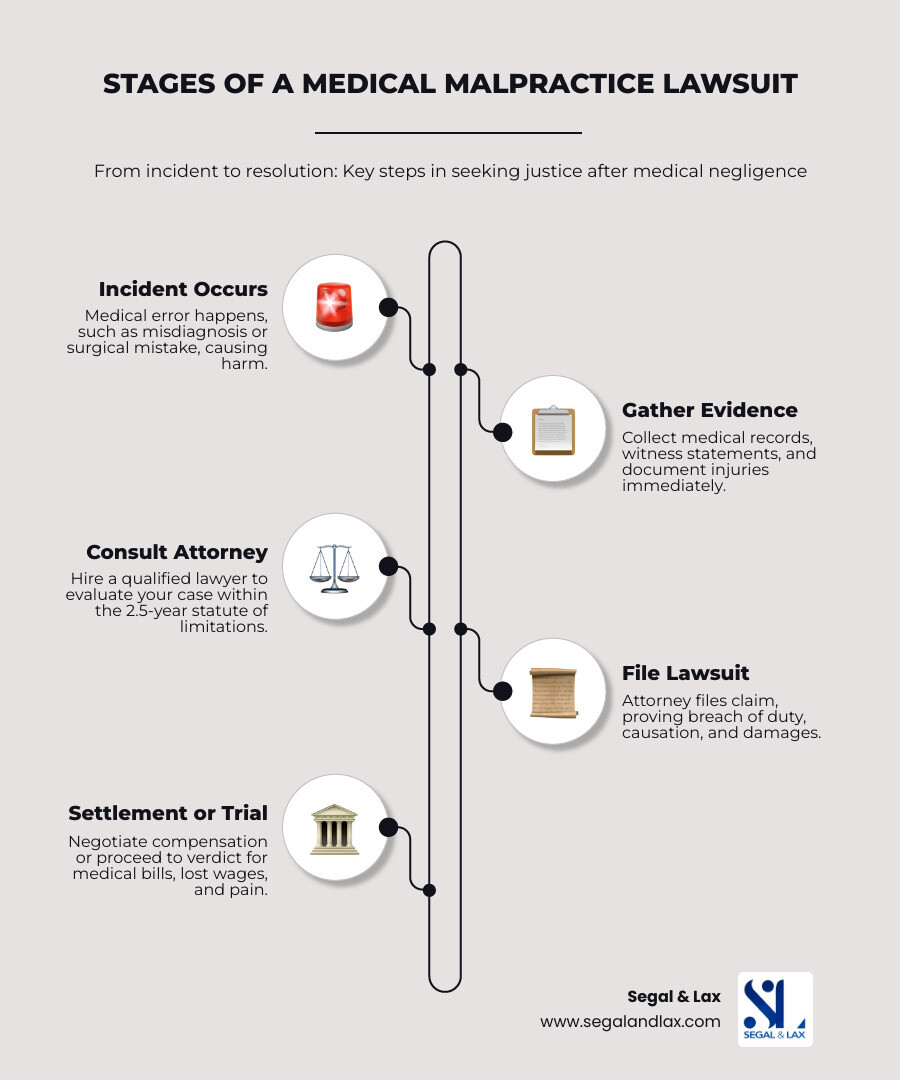
Medical malpractice lawyer Manhattan basics:
Understanding Medical Negligence in New York County
When we talk about medical malpractice in Manhattan, we are essentially talking about professional negligence. In the legal world of New York County, this occurs when a healthcare professional—whether a surgeon at Mount Sinai or a nurse at a clinic in Chelsea—fails to provide care that meets the “standard of care.”
The standard of care is defined as the level of care and skill that a reasonably prudent healthcare provider in the same specialty would provide under similar circumstances. To build a successful case, we must establish four specific pillars:
- The Physician-Patient Relationship: We must show that the doctor or facility owed you a duty of care because you were their patient.
- Breach of Duty: This is the “oops” moment, though usually much more serious. It means the provider deviated from the accepted standard of care.
- Proximate Cause: We have to prove that the provider’s mistake was the direct cause of your harm. It isn’t enough that they made a mistake; that mistake must be why you are injured now.
- Compensable Injury: You must have suffered actual damages, such as physical pain, emotional distress, or financial loss.
In many cases, the issue of informed consent also arises. Under New York law, doctors have a duty to explain the risks, benefits, and alternatives of a procedure. If they fail to do so and you are harmed by a risk you weren’t warned about, that may constitute Medical Malpractice.
While our team focuses on recovering financial compensation for you, you can also report professional misconduct to the New York State Department of Health. Their oversight helps ensure that dangerous practitioners are held accountable beyond the courtroom.
Common Cases Handled by a Medical Malpractice Lawyer Manhattan
Manhattan is home to some of the world’s most renowned medical institutions, but even in high-tech surgical suites at Mount Sinai Hospital or NewYork-Presbyterian, errors happen. A medical malpractice lawyer Manhattan frequently sees cases ranging from simple pharmacy mix-ups to catastrophic surgical blunders.
Common case types include:
- Failure to Diagnose Lawsuit: When a doctor misses a clear sign of illness.
- Medical Malpractice / Surgical Error: Such as operating on the wrong site or leaving equipment inside a patient.
- Birth Injury: Tragedies involving oxygen deprivation or physical trauma during delivery.
- Medication Mistakes: Administering the wrong drug or an incorrect dosage.
- Medical Malpractice / Emergency Room Errors: Mistakes made in high-pressure environments like the ERs near the FDR Drive.
- Anesthesia Complications: Incorrect dosing that leads to awareness during surgery or brain damage.
- Defective Medical Devices: Faulty implants or monitors that fail when patients need them most.
Diagnostic Errors and Failure to Treat
Did you know that failure to diagnose or mistakes in diagnosis account for over 40% of all medical malpractice claims? This is a staggering statistic. In a city as as New York, doctors sometimes rush through assessments, leading to a Medical Malpractice / Misdiagnosis & Delayed Diagnosis.
Commonly missed conditions include:
- Cancer: Failing to order a biopsy or misreading a mammogram.
- Heart Attacks: Dismissing chest pain as indigestion, especially in women or younger patients.
- Infections: Ignoring signs of sepsis until it is too late.
If an ambulance is racing down the FDR Drive to an emergency room, every second counts. If the admitting physician fails to recognize a stroke or cardiac event, the window for effective treatment slams shut, often leaving the patient with permanent disabilities.
Hospital Negligence and Surgical Mistakes
Surgical errors are often the most shocking. We’ve handled cases where “foreign objects”—like sponges or clamps—were left inside a patient’s body after a procedure at NewYork-Presbyterian/Lower Manhattan Hospital.
Hospital negligence isn’t just about the surgeons, though. It can involve:
- Nursing Errors: Failure to monitor a patient’s vitals post-surgery.
- Post-operative Infections: Not maintaining a sterile environment or failing to treat a budding infection.
- Wrong-site Surgery: A nightmare scenario where a surgeon operates on the left knee instead of the right.
Furthermore, negligence isn’t limited to hospitals. We also see significant cases of Nursing Home Abuse and neglect in long-term care facilities across Manhattan, where vulnerable seniors are denied the basic standard of care they deserve.
Key Legal Requirements and Filing Deadlines
Timing is everything in New York law. If you miss a deadline, your case is over before it starts. The general rule—the Statute of Limitations—for medical malpractice in New York is 2.5 years from the date of the alleged malpractice or the end of continuous treatment by the party you are suing.
However, there are some very important exceptions you should discuss with a medical malpractice lawyer Manhattan:
| Scenario | Deadline |
|---|---|
| Standard Malpractice | 2.5 years from incident or end of treatment |
| Foreign Object Left in Body | 1 year from discovery (or when it should have been discovered) |
| Lavern’s Law (Cancer Misdiagnosis) | 2.5 years from discovery (capped at 7 years from the error) |
| Minor Children | The clock usually starts at age 18 (capped at 10 years total) |
If you believe a professional has acted unethically, you can also look into filing a complaint with the Office of Professional Medical Conduct (OPMC) for doctors, or the Office of Professional Discipline for other licensed professionals like nurses and dentists.
Proving Your Medical Malpractice Lawyer Manhattan Case
To win, we need more than just a bad outcome. We need evidence. This typically starts with a deep dive into your medical records. In New York, we are also required to consult with a qualified physician before even filing a lawsuit to “certify” that your case has merit.
We use several tools to prove negligence:
- Medical Testimony: We bring in other doctors to explain how your provider messed up.
- Causation: We link the error directly to your current health problems.
- Res ipsa loquitur: This is a fancy Latin term meaning “the thing speaks for itself.” It’s used for obvious errors, like leaving a surgical tool inside a patient. In these cases, negligence is so clear that you don’t always need an expert to explain it.
While a car accident on the West Side Highway might be proven with skid marks and photos, clinical negligence is proven through data, lab results, and expert opinions.
Compensation and Damages in New York Claims
If your claim is successful, the goal is to “make you whole” again—or as close to it as money allows. Manhattan juries and insurance companies look at two main types of damages.
Economic Damages: These are the “receipt-based” losses.
- Past and future medical bills.
- Lost wages if you can’t work.
- The cost of home health aides or physical therapy.
Non-Economic Damages: This covers the human cost.
- Pain and suffering: The physical and emotional toll of the injury.
- Loss of enjoyment of life.
- Loss of companionship (in wrongful death cases).
A key benefit of filing in New York is that there are no caps on non-economic damages. Unlike some other states that limit what you can receive for pain and suffering, New York allows the jury to decide what is fair. This is one reason why a New York Malpractice Lawyer can often secure multi-million dollar settlements for catastrophic injuries.
Frequently Asked Questions about Manhattan Medical Negligence
How much does it cost to hire a medical malpractice lawyer Manhattan?
We understand that you are likely already facing massive medical bills. That’s why we work on a contingency fee basis. This means there are no upfront costs to you. We pay for the medical experts, the filing fees, and the records. We only get paid a percentage of the final settlement or jury award. If we don’t win, you don’t owe us a dime for our legal services. This levels the playing field, allowing “regular” people to take on giant hospital systems. You can learn more about this by speaking with a Personal Injury Lawyer in Manhattan.
Who can be held liable for my injuries?
Liability isn’t always limited to the person holding the scalpel. Depending on the facts, we may sue:
- Attending Physicians: The primary doctor in charge of your care.
- Registered Nurses: For medication errors or failure to monitor.
- Hospital Administration: For systemic failures or hiring unqualified staff.
- Medical Facilities: Including private clinics and urgent care centers.
- Skilled Nursing Centers: For neglect or improper wound care.
What should I do if I suspect medical negligence?
If you think something went wrong, take these steps immediately:
- Request Your Records: You have a legal right to your medical files. Get them before they can be “updated.”
- Get a Second Opinion: See a different doctor to fix the immediate health issue.
- Document Everything: Keep a journal of your symptoms and how they affect your daily life.
- Avoid Social Media: Don’t post about your health or your potential lawsuit; insurance companies are watching.
- Contact Legal Counsel: The clock is ticking. The sooner we can start investigating, the better.
Conclusion
Navigating the aftermath of medical errors is exhausting, but you don’t have to do it alone. At Segal & Lax, we bring over 75 years of combined experience to the table. We’ve seen the “horror stories” and we know how to fight back against insurance companies that want to minimize your pain.
Whether your injury happened in a Midtown clinic or a hospital in the East Village, our “no win, no fee” promise ensures that justice is accessible to everyone in all five boroughs. We are your neighbors, and we are ready to be your champions.
If you’re ready to take the next step, we are here to listen. More info about medical malpractice services is just a click away. Let us help you get the compensation you deserve so you can focus on what matters most: your recovery.