


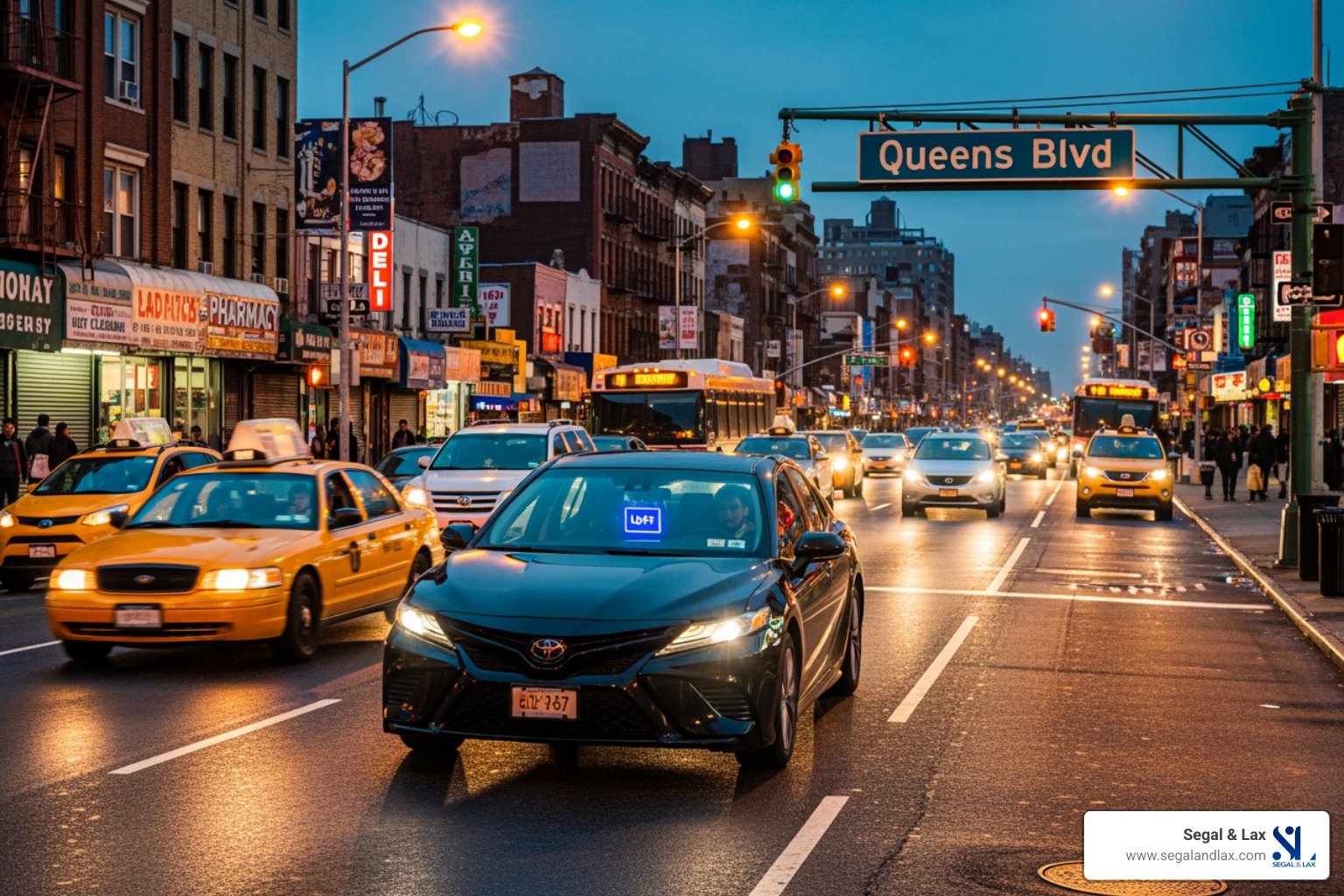
Injured in a Rideshare Crash? A Rideshare Accident Lawyer in Queens Explains Your Options
Why You Need a Queens Rideshare Accident Lawyer After a Crash
Queens rideshare accident lawyer services are essential if you’ve been injured in an Uber or Lyft crash. Rideshare accidents involve complex insurance policies that vary based on whether the driver was waiting for a ride request, en route to pick up a passenger, or actively transporting someone. Here’s what you need to know:
When to Hire a Queens Rideshare Accident Lawyer:
- You were injured as a passenger, pedestrian, cyclist, or driver in a crash involving an Uber or Lyft vehicle
- You’re unsure which insurance policy applies to your accident
- The rideshare company or insurance company is offering a low settlement
- Your injuries are serious or your medical bills exceed basic no-fault coverage
- You need help navigating New York’s comparative fault system
What a Lawyer Can Help You Recover:
- Medical expenses (current and future)
- Lost wages and loss of earning capacity
- Pain and suffering
- Property damage
- Wrongful death damages (if a loved one was killed)
Rideshare services like Uber and Lyft have transformed how New Yorkers get around Queens. But this convenience comes with increased traffic and accident risks. According to research, ride-share accidents have contributed to a 3% increase in car accident fatalities. The legal landscape is equally complicated—rideshare insurance coverage can range from $0 when the driver’s app is off to $1 million when a passenger is in the vehicle.
Whether you were a passenger in a rideshare vehicle, a pedestrian struck by an Uber driver, or another motorist hit by a Lyft car, determining liability and securing fair compensation requires understanding New York’s rideshare regulations and insurance policies.
I’m Mark Segal, and for over 75 years of combined experience with my firm Segal & Lax, we’ve been helping New Yorkers recover compensation after serious accidents, including complex rideshare crashes that require a Queens rideshare accident lawyer who understands both the technology and the law. We work on a contingency fee basis, which means you pay nothing unless we win your case.

Queens rideshare accident lawyer word roundup:
Understanding Liability: Who Pays for a Queens Rideshare Accident?
When you’re involved in a car accident in Queens, determining who is at fault and whose insurance should pay can be a straightforward process. But when a rideshare vehicle is involved, the situation becomes much more complicated. The question of “who is liable?” in a Queens rideshare accident is often multifaceted, involving the rideshare driver, the rideshare company (Uber or Lyft), other drivers, or even third parties like vehicle manufacturers if a defect contributed to the crash.
The challenge begins with the unique legal classification of rideshare drivers. Unlike traditional employees, Uber and Lyft drivers are typically considered independent contractors. This distinction significantly impacts the rideshare company’s direct liability for their drivers’ actions.
Rideshare companies and their insurers often employ strategies to minimize payouts, making it crucial to have a dedicated advocate on your side. We understand these tactics and are prepared to challenge them to secure the compensation you deserve. If you’ve been injured, a Queens rideshare accident lawyer from our firm can help you steer through these complexities.
Uber & Lyft Insurance Coverage Explained
One of the most critical aspects of a rideshare accident claim is understanding the insurance coverage. Uber and Lyft have tiered insurance policies that depend entirely on the driver’s “status” at the time of the accident. This can be incredibly confusing for accident victims, but it’s vital for determining which policy applies to your claim.
Here’s a breakdown of the three main periods of rideshare insurance coverage:
Period 0: Driver’s App is Off When a rideshare driver is not logged into the app, or is using their vehicle for personal use, their personal auto insurance policy is the primary and only coverage. Uber and Lyft provide no coverage in this scenario. New York State’s legal minimum insurance coverage for all drivers includes $10,000 for property damage, $25,000/$50,000 for bodily injury/death per person, and $50,000/$100,000 for bodily injury/death for multiple people.
Period 1: App On, Waiting for a Ride Request If the rideshare driver is logged into the app and available to accept a ride but has not yet accepted one, a limited contingent liability policy from Uber or Lyft may apply. This coverage kicks in if the driver’s personal insurance denies the claim or is insufficient.
Period 2 & 3: En Route to Pick Up Passenger OR Passenger in Vehicle This is when the most substantial coverage is active. From the moment a driver accepts a ride request until the passenger is dropped off, Uber and Lyft provide significant liability coverage.
Here’s a table summarizing the insurance coverage levels:
| Driver Status | Bodily Injury Coverage (per person) | Bodily Injury Coverage (per accident) | Property Damage Coverage (per accident) |
|---|---|---|---|
| App Off / Personal Use | Driver’s Personal Insurance | Driver’s Personal Insurance | Driver’s Personal Insurance |
| App On, Waiting for Request (Period 1) | $50,000 | $100,000 | $25,000 |
| En Route to Pick Up / Passenger in Vehicle (Periods 2 & 3) | Up to $1,000,000 | Up to $1,000,000 | Included within $1M coverage |
Navigating these different periods and determining which policy applies requires a thorough understanding of New York rideshare regulations. We can help you identify the applicable coverage and pursue your claim effectively.
The Driver’s Status: Independent Contractor vs. Employee
The classification of rideshare drivers as independent contractors, rather than employees, is a cornerstone of Uber and Lyft’s business model and a significant legal hurdle for accident victims.
This classification allows rideshare companies to distance themselves from direct liability for a driver’s negligence. They argue that because drivers are not employees, the company is not responsible for their actions in the same way an employer would be.
This often leads to rideshare companies trying to minimize their responsibility, denying claims by stating the driver was an independent contractor. However, this doesn’t mean you have no recourse. In some cases, it may still be possible to hold the rideshare company liable, especially if we can demonstrate negligence in their hiring practices, vehicle maintenance requirements, or safety measures.
Proving such negligence requires a detailed investigation and a deep understanding of Personal Injury law. We are well-versed in these arguments and can fight to secure the compensation you deserve.
Distinguishing Rideshare from Taxi Accidents
While both taxis and rideshare vehicles provide transportation services in Queens, the legal framework governing them and the claims process after an accident differ significantly. Understanding these distinctions is crucial for anyone involved in an accident.
- Driver Classification: Taxi drivers operate under commercial licenses and are often considered employees of a taxi company or operate under strict commercial regulations. Rideshare drivers, as we’ve discussed, are independent contractors. This fundamental difference affects whose insurance is primary and who can be held liable.
- Insurance Policies: Taxi companies are required to carry specific, comprehensive commercial insurance policies custom to their operations. Rideshare companies, on the other hand, have their tiered insurance system that varies based on the driver’s app status. This system can be more complex to steer.
- Regulation: Taxis are heavily regulated by the NYC Taxi and Limousine Commission (TLC), which mandates specific vehicle standards, driver training, and insurance requirements. While rideshare drivers in NYC also need a TLC license and are subject to some regulations (like vehicle caps and minimum pay rates), the overall regulatory landscape for rideshare companies is newer and constantly evolving.
These differences mean that a claim stemming from a taxi accident will be handled differently than a rideshare accident. An experienced Rideshare Accident Lawyer in Queens understands these nuances and can tailor the legal strategy to your specific situation, ensuring we target the correct parties and insurance policies.
Critical Steps to Take Immediately After a Rideshare Crash in Queens
The moments immediately following a rideshare accident in Queens can be chaotic and frightening. However, the actions you take (or don’t take) during this critical time can significantly impact the success of your future legal claim.
Prioritizing your safety and then protecting your rights by preserving evidence are paramount. We understand the confusion that comes with an accident, and we are here to help you steer through the aftermath. For more general information on what to do after any vehicle incident, visit our page on After an Accident.
At the Scene: Your First Priorities
Your health and safety are always the top priority. After ensuring your immediate well-being, follow these steps:
- Call 911: Even if you think your injuries are minor, or if there’s significant property damage, call the police to report the accident. This ensures an official police report is created, which is crucial documentation for your claim. If medical attention is needed, paramedics will be dispatched.
- Seek Immediate Medical Attention: Don’t delay seeing a doctor, even if you feel fine. Adrenaline can mask pain, and some serious injuries (like whiplash or internal injuries) may not manifest symptoms until hours or days later. Prompt medical evaluation creates an official record of your injuries linked to the accident.
- Exchange Information: Get the rideshare driver’s name, contact information, insurance details, and the rideshare company they work for (Uber or Lyft). Also, collect the same information from any other drivers involved.
- Document the Scene: Use your smartphone to take photos and videos of everything. This includes:
- Damage to all vehicles involved from multiple angles.
- The position of the vehicles.
- Skid marks, broken glass, or debris on the road.
- Traffic signs or signals at the intersection.
- The weather conditions.
- Any visible injuries you or others sustained.
- Get Witness Contacts: If anyone saw the accident, ask for their names and contact information. Witness testimony can be invaluable in establishing fault.
- Save the Ride Receipt from the App: This digital record proves you were using the rideshare service at the time of the accident and can provide details about the driver and trip.
Reporting the Accident and Seeking Legal Counsel
After handling the immediate aftermath, there are a couple of crucial steps to take:
- Notify the Rideshare Company: Report the incident through the Uber or Lyft app. This creates an official record with the company.
- Avoid Giving Recorded Statements to Insurers: Insurance adjusters, whether from the rideshare company or another party, may contact you quickly. Their primary goal is to protect their profits and minimize payouts, not necessarily to ensure you receive fair compensation. Do not give any recorded statements or sign any documents without first consulting with a Queens rideshare accident lawyer. Anything you say can be used against you to devalue your claim.
- Contact Us Promptly: Taking swift legal action is important to preserving the viability of your claim. The sooner you reach out, the sooner we can begin gathering evidence, investigating the accident, and protecting your rights. We can handle all communications with insurance companies on your behalf. To schedule a free consultation, please Contact Us today.
How a Queens Rideshare Accident Lawyer Builds Your Case
Building a strong case after a Queens rideshare accident requires a meticulous and strategic approach. At Segal & Lax, our process involves a thorough investigation, aggressive negotiation with insurance companies, and a willingness to litigate if necessary to maximize your compensation.
We bring our combined 75 years of experience to bear on every case, ensuring our clients’ stories reflect the dedicated and personalized approach that defines our work. For more reasons to choose us, visit our Why Hire Us page.
Our team will:
- Conduct a thorough investigation: This includes gathering all available evidence such as police reports, medical records, witness statements, rideshare app data, and even surveillance footage if available.
- Identify all liable parties: We’ll determine whether the rideshare driver, the rideshare company, another motorist, or even a vehicle manufacturer can be held responsible.
- Negotiate with insurers: Insurance adjusters are more concerned with protecting their profits than providing the compensation you deserve. We are seasoned in negotiating with them to challenge lowball offers and fight for fair settlements.
- Litigate if necessary: If a fair settlement cannot be reached through negotiation, we are prepared to take your case to court to secure the compensation you are entitled to.
What Compensation Can You Recover?
After a rideshare accident, you may be facing significant financial burdens and physical pain. Our goal is to help you recover compensation for all damages incurred. These can be broadly categorized into economic and non-economic damages:
Economic Damages: These are quantifiable financial losses directly resulting from the accident.
- Medical Expenses: This includes emergency room visits, hospital stays, surgeries, doctor appointments, physical therapy, prescription medications, and any future medical care related to your injuries.
- Lost Wages: Compensation for income you’ve lost due to being unable to work after the accident.
- Loss of Earning Capacity: If your injuries prevent you from returning to your previous job or earning the same income in the future, we can seek compensation for this long-term financial impact.
- Property Damage: Costs to repair or replace your vehicle or any other damaged personal property.
Non-Economic Damages: These are subjective, non-monetary losses that impact your quality of life.
- Pain and Suffering: Compensation for the physical pain and emotional distress caused by your injuries.
- Emotional Distress: This can include anxiety, depression, PTSD, and other psychological impacts of the accident.
- Loss of Consortium: In cases of severe injury, this compensates a spouse for the loss of companionship, affection, and support.
In cases where the at-fault party’s behavior was particularly reckless or malicious (e.g., drunk driving), punitive damages might also be awarded to punish the wrongdoer and deter similar conduct in the future.
Navigating New York’s Legal Framework for Your Claim
New York State has specific laws that govern personal injury claims, and these apply to Queens rideshare accident cases. Understanding these regulations is crucial for a successful outcome.
New York’s Pure Comparative Fault System: New York operates under a “pure comparative fault” system. This means that if you are found to be partially at fault for the accident, your compensation will be reduced by your percentage of fault, but you are not barred from recovery entirely. For example, if you are awarded $100,000 in damages but are found to be 20% at fault, you would receive $80,000. We will work diligently to minimize any alleged fault on your part.
Statute of Limitations: There are strict deadlines for filing a lawsuit in New York.
- For most personal injury claims, including those from a rideshare accident, you generally have three years from the date of the accident to file a lawsuit.
- If the accident resulted in a fatality, a wrongful death lawsuit typically must be filed within two years from the date of death.
These deadlines are critical. Missing them can mean losing your right to seek compensation forever. That’s why contacting a Queens rideshare accident lawyer as soon as possible is always in your best interest.
Common Causes of Rideshare Accidents
Accidents can happen for many reasons, but certain factors frequently contribute to Queens rideshare accidents. The unique pressures and nature of rideshare driving can sometimes exacerbate these risks:
- Driver Negligence: This is a broad category that includes many unsafe driving behaviors.
- Driver Distractions: Rideshare drivers often rely heavily on their smartphones for navigation, ride requests, and communication, making distracted driving a primary cause of accidents. Passenger interactions can also divert a driver’s attention from the road.
- Speeding to Complete More Rides: Drivers may feel pressured to complete as many rides as possible to maximize their earnings, leading to speeding and aggressive driving. Tragically, according to the National Highway Traffic Safety Administration (NHTSA), speeding was involved in more than one-third of all fatal crashes over the past two decades, with 9,378 deaths attributed to it in 2018 alone.
- Driver Fatigue: Long hours on the road, especially during peak times, can lead to fatigued driving, impairing a driver’s reaction time and judgment.
- Drunk Driving Accidents: Despite strict laws, some drivers still operate under the influence of alcohol or drugs, leading to devastating collisions.
- Inexperience with Queens Roads: Drivers unfamiliar with Queens’ complex network of highways, busy intersections, and local streets may struggle to steer safely, especially during peak traffic or adverse weather.
- Negligence of Other Motorists: Often, the rideshare vehicle is hit by another driver who is at fault.
- Hazardous Road Conditions: Potholes, poor lighting, or construction zones can contribute to accidents.
- Defective Vehicle Parts: Although less common, a mechanical failure due to a defective part could also cause an accident.
Frequently Asked Questions about Queens Rideshare Accidents
We understand you likely have many questions after a rideshare accident. Here are answers to some of the most common inquiries we receive:
What is my rideshare accident case worth?
This is one of the most common questions, and unfortunately, there’s no “average” settlement amount. The value of your Queens rideshare accident case depends on numerous factors, making each case unique. We will carefully assess all these elements to determine a fair value for your claim.
Key factors include:
- Severity of your injuries: More severe and long-lasting injuries typically result in higher compensation.
- Total economic losses: This includes all your medical bills (past and future), lost wages, and property damage.
- Strength of evidence: A strong, well-documented case with clear evidence of fault and damages is more likely to yield a favorable outcome.
- Available insurance coverage: The limits of the applicable insurance policies (personal, rideshare company, or other drivers’) will impact the maximum recoverable amount.
A free consultation is the best way to get a personalized estimate of what your case might be worth.
Can I sue Uber or Lyft directly for my injuries?
Suing Uber or Lyft directly can be challenging due to their classification of drivers as independent contractors. This legal distinction often allows the companies to argue they are not directly responsible for a driver’s negligence.
However, it is still possible to sue Uber or Lyft for injuries or wrongful death in certain circumstances. This typically involves proving that the company itself was negligent in some way. Examples of this could include:
- Negligent hiring: If the company failed to conduct proper background checks, leading to a driver with a history of unsafe driving.
- Failure to enforce safety policies: If the company knew a driver was repeatedly violating safety rules but took no action.
- Defective app technology: If a flaw in the rideshare app contributed to the accident.
Proving company fault requires an in-depth investigation and a deep understanding of corporate liability. A Queens rideshare accident lawyer from our firm can evaluate the specifics of your situation to determine if a direct claim against the rideshare company is viable.
Do I have to pay a lawyer upfront to handle my Queens rideshare accident lawyer case?
No, you do not have to pay us upfront to handle your Queens rideshare accident case. We understand that after an accident, you may be facing unexpected medical bills and lost income, making it difficult to afford legal fees. That’s why we work on a contingency fee basis.
This means:
- “No win, no fee” promise: You pay nothing unless we recover compensation for you through a settlement or a court verdict.
- No out-of-pocket costs: We cover all the upfront costs of litigation, including investigation expenses, court filing fees, and expert witness fees.
- Fees are paid from the settlement: Our legal fees are a percentage of the compensation we successfully recover for you.
This arrangement allows you to pursue justice without financial risk, ensuring that everyone has access to dedicated legal representation regardless of their current financial situation.
Get the Help You Need After a Rideshare Accident in Queens
The aftermath of a rideshare accident in Queens can be overwhelming. From navigating complex insurance policies and determining liability to understanding New York’s comparative fault system and strict statutes of limitations, the legal process is fraught with challenges. You shouldn’t have to face these complexities alone while also recovering from your injuries.
At Segal & Lax, we offer serious, personalized representation to victims of rideshare accidents across Queens and all five boroughs of New York City. With over 75 years of combined experience, our firm is dedicated to fighting aggressively to secure fair compensation for your medical bills, lost wages, pain, suffering, and property damage. We are committed to staying up-to-date on the latest legal precedents affecting rideshare claims, ensuring we provide you with the most effective advocacy.
Taking swift legal action is crucial for preserving the viability of your claim. Let us handle the legal complexities so you can focus on your recovery. We work on a contingency fee basis, meaning you pay nothing unless we win your case.
Don’t let the confusion of a rideshare accident prevent you from seeking the justice and compensation you deserve. Call us today to schedule your free consultation and take the first step toward recovery. For more information on how we can help with various vehicle incidents, visit our main page on Car Accidents.