


NYC Car Crash: Essential 2025 Trends
Why Understanding NYC Car Crash Data Matters
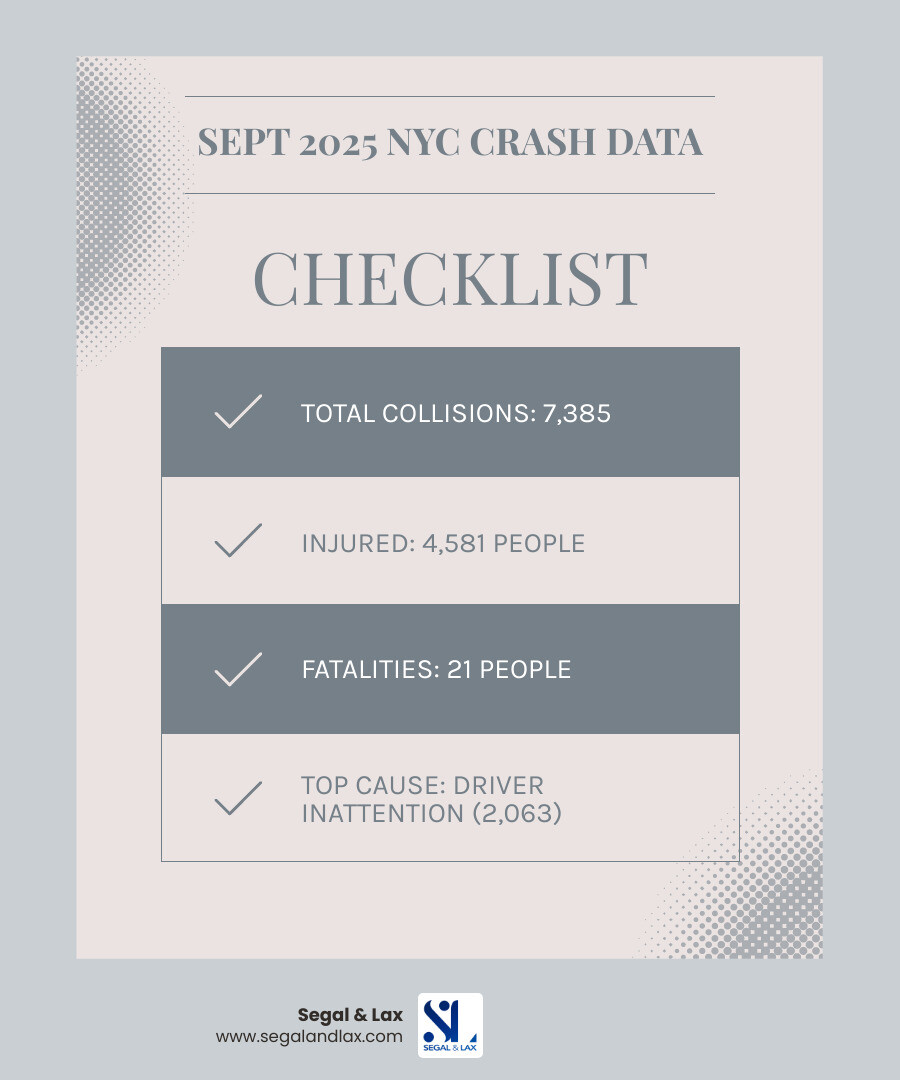
NYC car crash incidents are a daily reality in America’s most densely populated city. In September 2025 alone, New York City recorded 7,385 motor vehicle collisions, injuring 4,581 people and causing 21 fatalities. For every driver, cyclist, or pedestrian, these numbers highlight the importance of traffic safety.
Key NYC Car Crash Statistics (September 2025):
- Total Collisions: 7,385 citywide
- People Injured: 4,581 (1,921 motorists, 1,353 passengers, 539 cyclists, 768 pedestrians)
- Fatalities: 21 (11 motorists, 1 passenger, 2 cyclists, 7 pedestrians)
- Top Cause: Driver inattention/distraction (2,063 injury and fatal collisions)
- Most Affected Borough: Brooklyn (2,434 collisions)
The sheer volume of traffic in NYC creates unique challenges. With over 8 million residents plus millions of commuters and tourists, the city ranks among the nation’s worst for congestion. The human cost is significant, as these collisions leave many New Yorkers facing medical bills, lost wages, and life-altering injuries.
The data reveals clear patterns. Driver inattention and distraction is the leading cause of injury and fatal collisions, followed by following too closely and failure to yield. Analysis shows Brooklyn and Queens consistently have the most collisions due to their mix of residential streets and major thoroughfares. Manhattan sees fewer collisions due to slower speeds, but pedestrian incidents remain a concern.
I’m Mark Segal, and in my decades of practicing New York City personal injury law, I’ve represented countless victims of NYC car crash incidents. My firm understands that behind every statistic is a person whose life has been upended. We are committed to fighting for the compensation they need to rebuild.
Navigating the Numbers: A Snapshot of NYC Car Accidents
The numbers tell a sobering story. New York City sees thousands of NYC car crash incidents monthly. With over 8 million residents sharing the streets with commuters and tourists, these collisions are a daily reality.
September 2025 data shows 7,385 motor vehicle collisions, with 3,406 resulting in injuries or fatalities. The human toll was substantial: 1,921 motorists, 1,353 passengers, 539 cyclists, and 768 pedestrians were injured. Tragically, 21 people lost their lives, including 11 motorists, 1 passenger, 2 cyclists, and 7 pedestrians. These collisions involved a total of 13,927 motorists, 1,354 passengers, 541 cyclists, and 775 pedestrians, highlighting the constant risk on city streets.
At Segal & Lax, we’ve spent decades representing victims of these collisions. We’ve seen how a single NYC car crash can upend families with medical bills and lost wages. The statistics matter because they represent real people who need help.
The Borough Breakdown: Where Do Most Collisions Occur?
Not all boroughs face equal risk. Each has its own traffic patterns and collision profile.
Brooklyn leads the city with 2,434 collisions in September 2025, followed by Queens with 2,143. Together, these two boroughs account for over 60% of all NYC car crash incidents. This is due to a mix of residential neighborhoods, busy commercial corridors, and major arterial roads. Manhattan recorded 1,345 collisions, with slower speeds from congestion reducing frequency but not eliminating risk, especially for pedestrians. The Bronx saw 1,078 collisions, while Staten Island had 385.
| Borough | Total Collisions | Injuries | Fatalities |
|---|---|---|---|
| Brooklyn | 2,434 | Data for individual borough injury/fatality counts not available for September 2025 | |
| Queens | 2,143 | ||
| Manhattan | 1,345 | ||
| Bronx | 1,078 | ||
| Staten Island | 385 | ||
| Citywide | 7,385 | 4,581 | 21 |
Understanding where collisions happen most helps identify high-risk areas and advocate for safety improvements.
Who is Most Affected? A Look at Victims
Every number in NYC car crash data represents a person. The statistics show that motorists, passengers, cyclists, and pedestrians all face dangers on city streets.
In September 2025, motorists were involved in the highest numbers (13,927), with 1,921 injured and 11 killed. Passengers also faced significant risk, with 1,353 injured and 1 killed out of 1,354 involved. These are often the most vulnerable, with no control over the vehicle.
The vulnerability of those outside vehicles is clear. Pedestrians accounted for 7 of the 21 fatalities, the highest of any group. Of 775 pedestrians involved in collisions, 768 were injured. Pedestrian Accidents are among the most devastating collisions, often causing life-altering injuries.
Cyclists also face considerable danger. In September 2025, 541 cyclists were involved in collisions, with 539 injured and 2 killed. Bicycle Accidents are concerning because cyclists have little protection, making even low-speed impacts potentially catastrophic. Motorcyclists share the same vulnerability, and their involvement in crashes has risen in recent years.
The pattern is clear: while motorists are in the most collisions, pedestrians and cyclists often suffer the most severe consequences. These aren’t just statistics to us at Segal & Lax—they’re the people we fight for every day.
The Anatomy of an NYC Car Crash: Common Causes and Contributing Factors
When we look at the statistics behind every NYC car crash, a clear pattern emerges: most collisions happen because of human choices. Understanding these causes is essential for determining responsibility when someone gets hurt.
After decades of representing accident victims, I can tell you that driver negligence is at the heart of most collisions. At Segal & Lax, we examine every detail of how an accident occurred to build the strongest case for our clients. The various Causes of Car Accidents we handle share one common thread: someone’s negligence changed lives forever.
The Top Cause: Driver Inattention and Distraction
Driver inattention and distraction caused 2,063 injury and fatal collisions in NYC during September 2025 alone, more than any other single factor. These Driver Distractions include texting, talking on the phone, eating, or adjusting the GPS. Any activity that takes a driver’s focus off the road is dangerous. A car traveling at 35 mph covers about 50 feet per second. A two-second glance at a phone means the car travels 100 feet with no one in control—enough distance for a pedestrian to enter a crosswalk or for traffic to stop suddenly.
Distraction isn’t the only form of inattention. Following too closely contributed to 513 injury and fatal collisions in September 2025. Tailgating eliminates the buffer zone needed to react to sudden stops, leading to preventable rear-end collisions.
Failure to yield right-of-way contributed to 491 injury and fatal collisions during the same month. This often happens at intersections when drivers are impatient or not paying attention, resulting in dangerous T-bone collisions.
Other Major Factors in an NYC Car Crash
While distraction dominates, several other factors cause NYC car crash incidents.
- Unsafe speed contributed to 316 injury and fatal collisions in September 2025. This includes breaking the speed limit and driving too fast for conditions like rain or poor visibility. Higher speeds reduce reaction time and dramatically increase impact force.
- Improper lane usage and passing, such as weaving without signaling or drifting across lanes, risk sideswipe collisions and force other drivers into dangerous maneuvers.
- Drunk driving remains a tragic cause of catastrophic crashes. While accounting for a smaller percentage of total collisions, the severity of Drunk Driving Accidents is often devastating and completely preventable.
- Aggressive driving (tailgating, cutting off others, brake-checking) and disregarding traffic controls (running red lights, ignoring stop signs) are other forms of negligence that lead to predictable and severe collisions.
- Road conditions like potholes, poor lighting, or bad weather can also contribute, especially when a driver fails to adjust their behavior accordingly.
These factors illustrate the complex reality of traffic safety in New York City and help determine who should be held accountable.
After the Collision: Procedures, Reports, and City Initiatives
Being involved in an NYC car crash can be chaotic. Knowing the official procedures for reporting the incident and obtaining records provides clarity. The NYPD plays a central role in documenting collisions, and their data forms the backbone of city-wide safety efforts like the Vision Zero initiative, which aims to eliminate traffic fatalities.
Reporting a Crash and Obtaining Records
If you’ve been in a collision in New York City, proper reporting is essential for protecting your rights.
- For property damage collisions with no injuries, the NYPD has specific procedures, which are detailed on their official Traffic Collision Statistics page.
- For injury or fatal collisions, or if property damage exceeds $1,000, a police report (MV-104AN) is required. This report documents the crash event, vehicles, and circumstances. The NYPD provides Fatal collision / Critical Injury – FAQs for guidance.
- To obtain a police report, involved parties can submit a request to the NYPD with the required personal and vehicle information. This official document is crucial for insurance claims or legal action.
- For broader crash data, the City of New York offers public access to its Motor Vehicle Collisions – Crashes data tables, with records from all police-reported collisions since April 2016.
Navigating the aftermath involves more than paperwork. We’ve created a guide on what to do After an Accident on our website.
NYC’s Vision Zero: A Push for Safer Streets
New York City’s Vision Zero initiative, launched in 2014, operates on the belief that every traffic fatality is preventable. It’s an ambitious goal to make our roads safer for everyone.
The initiative uses a multi-faceted approach, relying on detailed NYC car crash data to identify dangerous areas and behaviors. Key strategies include:
- Street Redesign: Re-engineering streets to prioritize safety for vulnerable users like pedestrians and cyclists. This includes protected bike lanes, pedestrian islands, and expanded sidewalks.
- Targeted Enforcement: Directing NYPD resources to focus on high-risk behaviors like speeding, failure to yield, and distracted driving.
- Public Education: Campaigns designed to shift the culture around traffic safety and promote shared responsibility on the road.
While challenges remain, Vision Zero has brought a heightened focus to traffic safety in New York City, using data and strategic interventions to make our streets safer.
Frequently Asked Questions about an NYC Car Crash
What is the most common type of vehicle involved in NYC collisions?
Collision statistics reflect the types of vehicles most common on NYC roads. Passenger vehicles are involved in the most crashes, accounting for 5,539 collisions in September 2025. Sport utility vehicles (SUVs) and station wagons were second, involved in 4,268 collisions.
Other vehicle types include taxis (321 collisions), vans (111 collisions), and large commercial vehicles (563 collisions). These numbers indicate which vehicles are most frequently involved, not necessarily which are at fault.
What should I do immediately after a car accident in NYC?
The actions you take immediately after an NYC car crash can impact your health and any future claim. Follow these steps:
- Check for injuries and call 911. Assess yourself and others. If anyone is hurt or there is significant damage, call 911 immediately.
- Move to a safe location. If possible, move your vehicle out of traffic and turn on your hazard lights.
- Exchange information. Get the other drivers’ names, contact info, insurance details, driver’s license numbers, and license plate numbers.
- Document everything. Use your phone to take photos of the vehicles, damage, the scene, road conditions, and any visible injuries.
- Do not admit fault. Stick to the facts when speaking with police and other drivers. Apologies can be used against you later.
- Seek medical attention. See a doctor as soon as possible, even if you feel fine. Adrenaline can mask injuries, and a medical record is crucial for a claim.
- Notify your insurance company. Report the accident, but stick to the facts and avoid discussing fault.
For more details, see our guide on what to do After an Accident.
How does New York’s “no-fault” law affect my claim?
New York’s “no-fault” law means you first turn to your own insurance for coverage after an NYC car crash, regardless of who was at fault. Your Personal Injury Protection (PIP) coverage pays for your medical bills, lost wages, and other necessary expenses up to your policy limits. The NYS Department of Financial Services explains No-fault insurance laws explained in detail.
The system is designed to get injured people care quickly. However, you generally cannot sue the at-fault driver for pain and suffering unless your injuries meet the “serious injury” threshold defined by New York law. This includes injuries like bone fractures, significant disfigurement, or an injury that prevents you from performing daily activities for 90 of the 180 days post-accident.
If your injuries meet this threshold, you can file a lawsuit against the negligent driver for damages beyond your PIP coverage. If the at-fault driver is uninsured, your own uninsured motorist coverage is critical. You can read more about Uninsured Motorist Claims on our site.
Determining if your injury meets the threshold can be complex and is often disputed by insurance companies, which is why experienced legal representation is so important.
Navigating the Aftermath of a Collision
An NYC car crash is an all-too-common event that impacts thousands of lives monthly. Understanding the data, from causes like distracted driving to procedures for obtaining a report, is important. But beyond the statistics, there’s a personal side to every collision. If you’ve been injured, the journey to recovery—navigating medical treatments, insurance companies, and financial uncertainty—can be overwhelming.
That’s where we come in. At Segal & Lax, we understand the toll an NYC car crash can take. Our team is here to offer the support and representation you need. We operate on a “no win, no fee” basis, so you pay nothing unless we secure compensation for you. Our goal is to fight for the justice and financial recovery you deserve.
For guidance on your specific situation, we invite you to learn more about our approach to helping victims of Car Accidents. We’re here to help you steer this complex time so you can focus on healing.