



Sidewalk Accident Lawyer NYC: 5 Essential Tips
Why Understanding Sidewalk Liability Matters in New York City
Sidewalk accident lawyer NYC cases are among the most common personal injury claims in New York City. With over 12,750 miles of sidewalks throughout the five boroughs, New Yorkers walk more than residents of almost any other American city. Every day, pedestrians steer cracked pavement, uneven slabs, tree roots, ice, and debris. When these hazards cause serious injuries, understanding who is responsible can be confusing.
If you’ve been injured on a New York City sidewalk, here’s what you need to know:
- Property owners are generally responsible for maintaining sidewalks adjacent to their buildings under NYC Administrative Code § 7-210
- The City of New York remains liable for sidewalks next to one-, two-, or three-family owner-occupied homes
- You must file a Notice of Claim within 90 days if suing the city
- You typically have three years to file a lawsuit against a private property owner
- You can recover compensation for medical bills, lost wages, pain and suffering, and more
Sidewalk accidents can cause devastating injuries, from broken bones to traumatic brain injuries. Falls are a serious issue; in 2016, falls among older adults in NYC led to 289 deaths and thousands of hospitalizations. These aren’t minor stumbles but life-changing events that can result in mounting medical bills, lost income, and long-term disability.
The legal landscape is complex, with different rules for commercial, residential, and city-owned property. Snow and ice cases have unique rules, and missing a critical deadline—like the 90-day Notice of Claim for city cases—can prevent you from recovering any compensation.
I’m Mark Segal, and at Segal & Lax, we’ve dedicated 75 years of combined experience to helping injured New Yorkers steer these complex sidewalk accident cases. As a sidewalk accident lawyer NYC residents trust, I’ve seen how these injuries impact lives and how the right legal representation can make all the difference in securing the compensation you deserve.
Understanding Liability for New York City Sidewalk Accidents
When you’re injured on a New York City sidewalk, determining responsibility isn’t always simple. Premises Liability law holds property owners accountable for keeping their premises, including adjacent sidewalks, reasonably safe. New York City has specific laws that shift this responsibility based on the type of property and the defect that caused your fall. As a sidewalk accident lawyer NYC who has handled hundreds of these cases, I know that understanding these distinctions is critical to your claim.
Property Owner Responsibility Under New York City Law
In most cases, the adjacent property owner is legally responsible for a sidewalk injury. Under New York City Administrative Code § 7-210, property owners are responsible for maintaining the sidewalks adjacent to their property in a safe condition.
“Maintaining in a safe condition” means property owners must inspect their sidewalks, fix problems, and keep them free from hazards. Common issues include:
- Cracked or broken pavement: A simple crack can become a dangerous gap that catches a pedestrian’s shoe.
- Uneven surfaces: A height difference of just half an inch between sidewalk slabs is considered an unsafe tripping hazard under the NYC Administrative Code.
- Tree roots: As roots expand, they push up concrete slabs, creating sudden ridges that can send you tumbling.
- Defective cellar doors: Metal doors built into sidewalks can be serious dangers. When these doors are left open without warning signs, have broken hinges, or feature faulty grates, the building owner has a duty to warn pedestrians and keep them properly maintained. I’ve represented clients who’ve suffered catastrophic injuries after falling down steep stairs into basements.
When property owners fail to repair damaged areas, they can be held liable for the injuries that result.
When the City of New York is Liable
While property owners handle most sidewalk maintenance, the City of New York is still responsible in certain situations. The biggest exception involves one-, two-, or three-family owner-occupied residential homes. If you’re injured on a sidewalk next to someone’s personal home, the city—not the homeowner—is legally responsible. The NYC Department of Transportation also maintains sidewalks on city-owned property, like those next to parks or government buildings.
However, suing the City of New York is much harder than suing a private owner due to the “prior written notice” rule (NYC Administrative Code § 7-201). To win, you must prove the City received formal written notice of the specific defect before your accident and had a reasonable time to fix it. A simple call to 311 is not enough. We can sometimes find this evidence in official records, including maps from the Big Apple Pothole and Sidewalk Protection Committee. Without this proof, winning against the city is extremely difficult, which is why having an experienced sidewalk accident lawyer NYC is so important.
Special Cases: Snow, Ice, and Temporary Hazards
Winter in New York City transforms sidewalks into obstacle courses. Property owners have specific responsibilities for snow and ice, but the rules are different from regular maintenance.
- The “four-hour rule” requires property owners to clear snow and ice from their sidewalks within four hours after snowfall stops, but only if it’s between 7 a.m. and 9 p.m. If snow falls overnight, they have until 11 a.m. the next morning to clear it.
- The “storm in progress doctrine” protects property owners during active snowfall. Their responsibility to clear the sidewalk begins after the storm ends.
Sidewalks can also become dangerous due to construction debris, tools, or other obstructions. These situations fall under Slip and Falls or trip and fall accidents. The key is proving who was responsible for the temporary hazard and whether they knew (or should have known) it was there.
Immediate Steps to Take After a Sidewalk Accident in New York City
After a fall on a broken sidewalk, the moments that follow are disorienting but crucial. The steps you take can make a significant difference for both your health and your ability to get the compensation you deserve.
Following these steps can protect your health and preserve your legal rights after a Sidewalk Accident.
Document the Scene and Your Injuries
If you are physically able, try to gather evidence at the scene before leaving.
- Seek immediate medical attention. Your health is the priority, and a medical visit creates a record tying your injuries to the accident. Some injuries, like head trauma or internal damage, aren’t immediately apparent. See a doctor as soon as possible and tell them exactly how and when you fell. This documentation is crucial evidence.
- Photograph everything. Use your phone to take clear photos of the sidewalk defect that caused your fall. Get close-up and wide-angle shots. If possible, use a coin or your shoe for scale to document the size of the defect. A height difference of at least half an inch is considered a hazard in New York City.
- Document your injuries and gather witness information. Photograph any visible injuries, such as scrapes, bruises, or torn clothing. If anyone saw you fall, get their contact information. Their testimony can be powerful evidence later. For more guidance, see our article on What to do after a slip fall accident.
- Keep the shoes and clothes you were wearing. Do not wash or discard them, as they can serve as evidence.
Reporting the Incident and Filing a Notice of Claim
After addressing your medical needs, begin the official reporting process. This is where many people make critical mistakes.
Report the accident to the property owner if the fall occurred in front of a private building. Ask the building manager to create an incident report and get a copy. Consider filing a police report for severe injuries.
Here is the most critical deadline: if the City of New York might be responsible, you have only 90 days to file a Notice of Claim. This formal document informs the city of your intent to sue. If you miss this deadline, your case is likely over, regardless of your injuries. This rule applies to sidewalks next to one-, two-, or three-family owner-occupied homes and city-owned property.
After filing the Notice of Claim, you must file your lawsuit against the city within one year and 90 days of the accident. For private property owners, the statute of limitations is typically three years, but waiting is never a good idea. Evidence disappears and memories fade.
This is why you need a sidewalk accident lawyer NYC on your side immediately. We know these deadlines and handle the legal maneuvering so you can focus on healing.
Building Your Case with a Sidewalk Accident Lawyer NYC
After a sidewalk accident in New York City, you may be dealing with physical pain, mounting medical bills, and lost time from work. The stress can be overwhelming. A sidewalk accident lawyer NYC can steer the complex legal system to help you secure the compensation you deserve for your Personal Injury.
How a Sidewalk Accident Lawyer NYC Investigates Your Claim
Building a strong case requires a meticulous investigation. As your sidewalk accident lawyer NYC, we will examine every detail of your accident.
We start by gathering evidence, including your photos, witness interviews, and medical records. We’ll also seek surveillance footage from nearby businesses. Proving negligence is at the heart of your case. We must show that the responsible party had a legal duty to keep the sidewalk safe, failed to do so, and that this failure directly caused your injuries and damages.
Identifying liable parties can be complex. Was it the property owner, the City of New York, a commercial tenant, or a utility company? We dig deep to find everyone who shares responsibility. For more on our approach, visit our page on How an attorney can help after a sidewalk accident.
We also review maintenance records and prior complaints to prove the owner knew about the dangerous condition. If no prior complaint exists, we can argue “constructive notice”—that the defect was so obvious they should have known about it. Sometimes we consult with accident reconstructionists or engineers to strengthen a claim. Property owners and government agencies will likely deny your claim; we take that burden off your shoulders.
What Compensation Can You Recover?
Sidewalk accidents can have a staggering financial impact. We work to ensure you receive full compensation for all your losses.
- Medical expenses: We seek compensation for all past and future medical care, including ER visits, surgeries, physical therapy, and medications.
- Lost wages and earning capacity: You deserve compensation for lost income while you recover. If your injuries affect your ability to earn a living in the future, we fight for that diminished capacity.
- Pain and suffering: This compensation acknowledges the physical pain and limitations on your daily life caused by the injury.
- Emotional distress: Accidents can cause anxiety, depression, and other psychological trauma. We ensure these non-economic damages are part of your claim.
Common injuries from sidewalk accidents in New York City include fractures (wrists, ankles, hips), head injuries (from concussions to traumatic brain injuries), and spinal cord damage (herniated discs, pinched nerves). Serious injuries from falls are common and can be life-altering, often requiring extensive medical treatment and long rehabilitation. We work to ensure all these costs are covered in your claim.
At Segal & Lax, we work on a “no win, no fee” basis. You don’t pay us anything unless we recover compensation for you. That means we’re as invested in winning your case as you are.
Frequently Asked Questions about New York City Sidewalk Injury Claims
After a sidewalk accident, most people feel overwhelmed and uncertain about what comes next. As a sidewalk accident lawyer NYC residents turn to, we hear certain questions again and again. Here are the answers to help you understand your situation better.
What are the most common causes of sidewalk accidents in New York City?
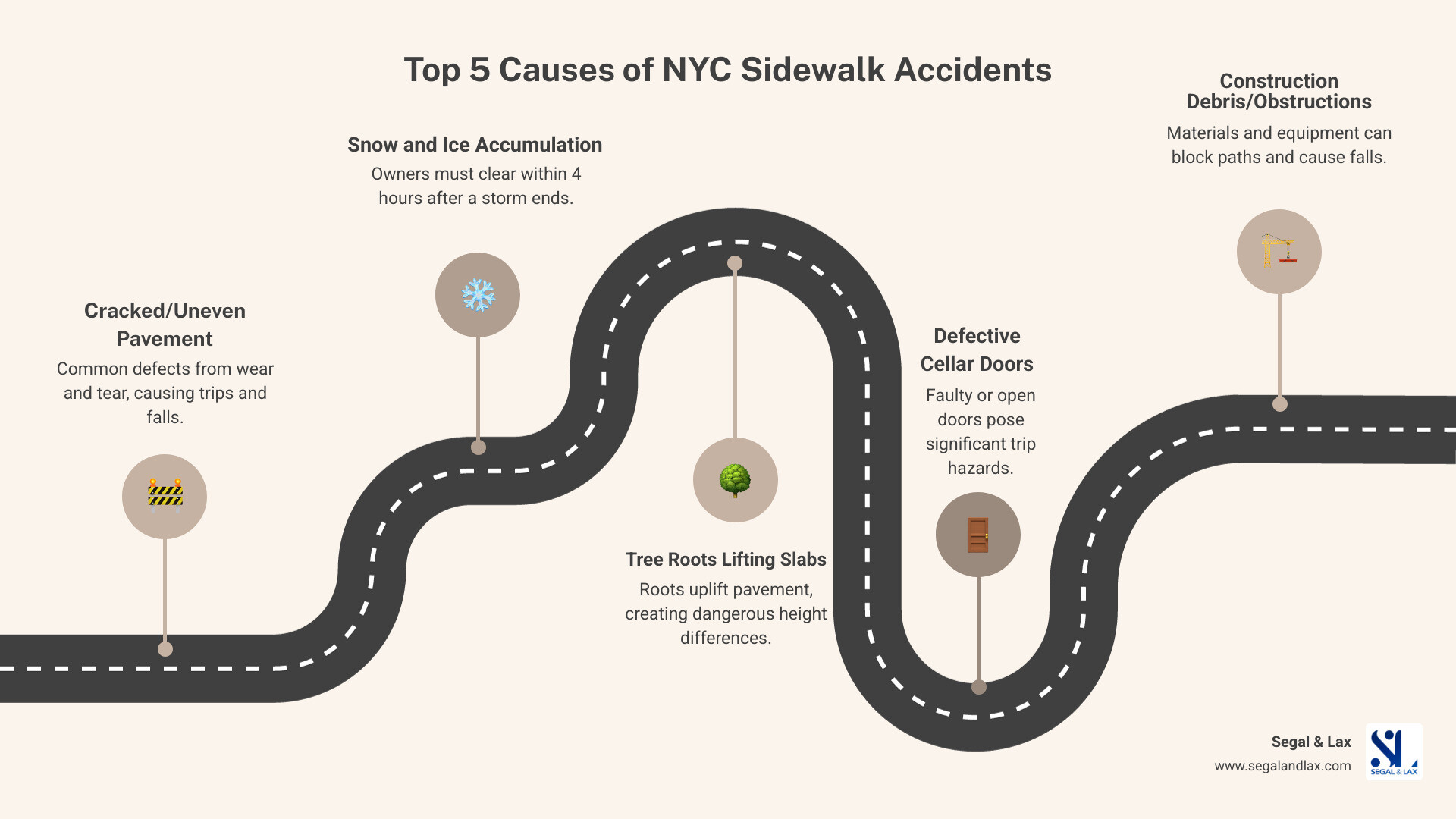
The most common causes of sidewalk accidents in New York City include:
- Cracked and uneven pavement: A height difference of just half an inch between slabs is considered a trip hazard by the NYC Administrative Code.
- Tree roots: Expanding roots can buckle and lift sidewalk slabs, creating dangerous, uneven surfaces.
- Snow and ice: Property owners who fail to clear sidewalks within four hours of a snowfall (between 7 a.m. and 9 p.m.) can be held liable.
- Defective cellar doors: Doors left open without warnings, or those with faulty grates, can lead to catastrophic falls.
- Other hazards: Potholes, construction debris, garbage, and poor lighting also contribute to many serious injuries.
What is the role of premises liability in a sidewalk accident case?
Premises liability is the legal principle that holds property owners responsible for keeping their property, including adjacent sidewalks, reasonably safe. To build a case, we must prove:
- A dangerous condition existed.
- The owner knew or should have known about it (this is called “actual or constructive notice”).
- They failed to fix the hazard or warn people about it.
- This failure directly caused your injury.
This legal framework ensures property owners are held accountable for neglecting safety, which protects all pedestrians. You can learn more about how this principle works on our What is Premises Liability? page, where we explain the concept in greater detail.
How can a sidewalk accident lawyer NYC help if I’m partially at fault?
Many people worry they can’t recover compensation if they were partially at fault for their accident, but that’s not true in New York. The state follows a “pure comparative negligence” rule. This means you can still recover damages even if you are partially responsible for your fall; your award is just reduced by your percentage of fault.
For example, if a jury finds you 20% at fault in a case worth $100,000, you could still receive $80,000. This is where having a sidewalk accident lawyer NYC is crucial. Insurance companies will try to shift as much blame as possible onto you, arguing you weren’t paying attention or should have seen the hazard. Our job is to fight these arguments, minimize any fault attributed to you, and maximize your compensation.
Don’t let concerns about partial fault stop you from seeking the compensation you deserve. Even if you think you share some responsibility, you should contact us for an honest assessment of your case.
Conclusion: Taking the Next Step Towards Your Recovery in New York City
A sidewalk accident can turn your life upside down in an instant, leaving you with pain, mounting medical bills, and lost wages. While you are trying to recover, you are also expected to steer a complex legal system.
You don’t have to do this alone.
This guide has covered the essentials: understanding liability in New York City, the critical 90-day deadline for claims against the city, immediate steps to take after an accident, and the compensation you can recover. These points are crucial for getting the compensation you deserve instead of shouldering the burden alone.
At Segal & Lax, we’ve spent 75 years of combined experience helping injured New Yorkers through exactly these situations. As a sidewalk accident lawyer NYC residents have trusted for generations, we understand the city’s specific sidewalk laws inside and out. We know how to prove negligence, identify all potentially liable parties, and fight for maximum compensation.
We believe serious injuries deserve serious representation, but cost should never be a barrier to justice. That’s why we work on a “no win, no fee” contingency basis. You pay nothing unless we recover compensation for you. No upfront costs. No hourly fees. No risk to you.
But here’s what you need to understand: time is not on your side. If your accident involves the City of New York, you have just 90 days to file a Notice of Claim. Miss that deadline, and your case is over. Even for cases against private property owners, evidence disappears and witnesses forget details. The sooner you act, the stronger your case will be.
If you or someone you love has been injured on a sidewalk in Manhattan, The Bronx, Queens, Staten Island, or Brooklyn, reach out to us today for a free consultation. We’ll listen to your story, review your case, and explain your legal options. There’s no obligation, no pressure—just honest guidance from people who genuinely care about your recovery.
For a complete understanding of your rights after being injured as a pedestrian, see our guide on Pedestrian Accidents.
Your recovery starts with a single step. Let us help you take it.