


Top lyft accident lawyer Queens: Definitive 2026
When a Lyft Ride in Queens Leads to Injury
A lyft accident lawyer Queens helps injured passengers, pedestrians, and other drivers recover compensation after rideshare crashes by navigating New York’s complex no-fault insurance system and Lyft’s tiered liability coverage. These attorneys work on a contingency fee basis, meaning you pay nothing unless you win.
Quick Answer: What to Do Right Now
- Call 911 and get medical care immediately (even if injuries seem minor)
- Document everything – photos of vehicles, injuries, location, and your Lyft app trip details
- Report to police – file an official accident report
- Don’t speak to insurance adjusters without legal representation
- Contact a Queens Lyft accident attorney within 30 days to protect your rights
There are times when rideshare services like Lyft can seem like a Godsend. They offer convenient alternatives to taxis after a night out in Flushing or a quick trip from LaGuardia Airport. But what happens when you’re injured in an accident with a Lyft driver on Queens Boulevard or the Grand Central Parkway?
The reality is stark: with over 65,000 rideshare-affiliated vehicles operating in New York City, thousands of people are getting injured in these crashes every year. Queens sees particularly high rideshare traffic due to its proximity to both JFK and LaGuardia airports, making accidents increasingly common.
Lyft accidents are not like regular car crashes. The legal landscape is far more complicated. You’re dealing with independent contractors, multiple insurance policies that shift based on the driver’s app status, and corporate legal teams trained to minimize payouts. New York’s no-fault insurance system adds another layer of complexity, with strict deadlines and a “serious injury” threshold you must meet to seek full compensation.
This guide breaks down everything you need to know about Lyft accidents in Queens – from the immediate steps you must take at the scene to understanding when Lyft’s $1.25 million insurance policy applies versus their limited $50,000 coverage. You’ll learn how liability works when a driver is logged into the app but hasn’t accepted a ride, what the 30-day filing deadline means for your claim, and why the three-year statute of limitations in New York requires immediate action.
If you’ve been hurt, time is critical. Evidence disappears quickly – surveillance footage from nearby businesses is often erased within 30 days, and digital trip data can vanish from your app.
For a general overview of how ridesharing functions in the city, you can also review this background on transportation in New York City.
The Immediate Aftermath: Critical Steps After a Lyft Crash in Queens
When a crash happens on Queens Boulevard, the Van Wyck Expressway, or outside LaGuardia, the right moves in the first hour can make or break your claim.
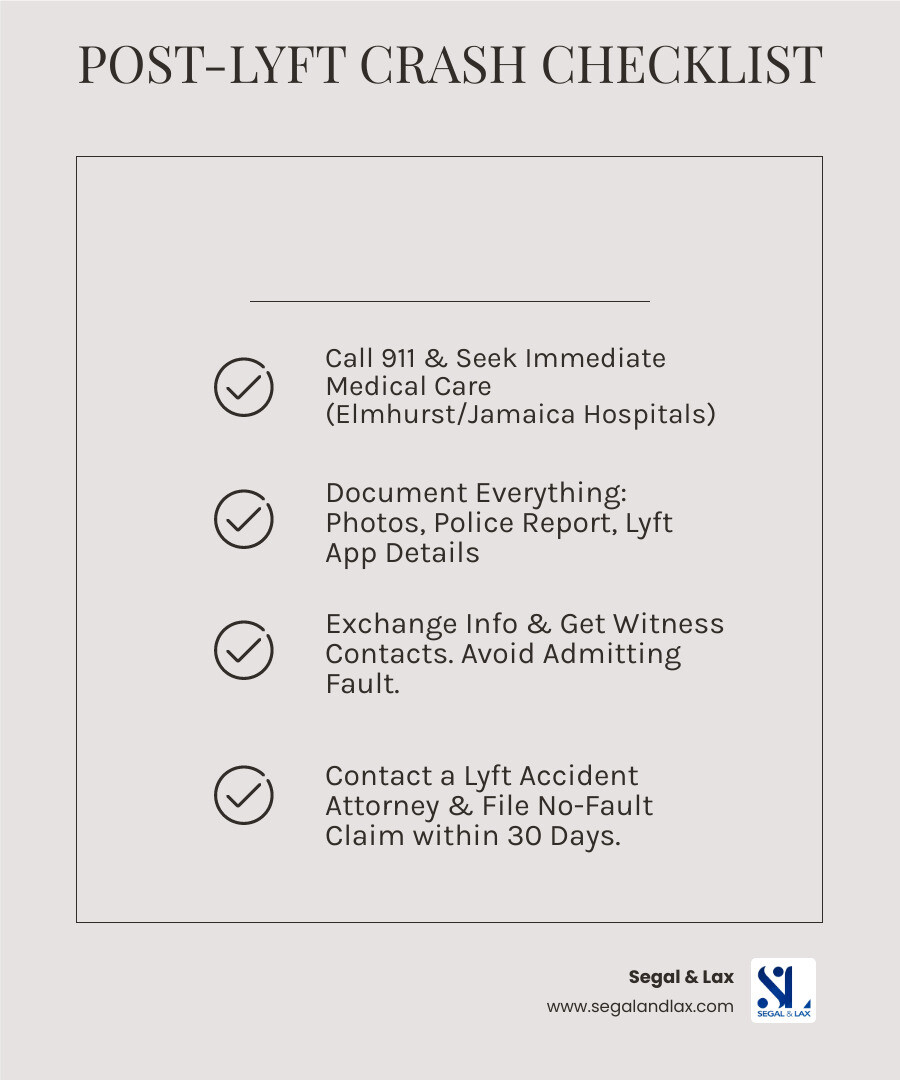
- Call 911 and seek medical care right away. In Queens, common destinations include Elmhurst Hospital and Jamaica Hospital Medical Center. Adrenaline masks pain; getting checked creates a medical record that ties injuries to the crash.
- Ensure safety. Move vehicles out of traffic if possible, use hazard lights, and watch for aggressive traffic on the Grand Central Parkway and Long Island Expressway (I-495).
- File a police report. The NYPD report is vital, and you may also need to file an MV-104 report with the NYS DMV. Ask for the precinct case number.
- Document the scene. Take wide and close-up photos and videos of damage, skid marks, debris, traffic signals, weather, and your injuries.
- Exchange information. Get the Lyft driver’s name, TLC license number, plate, insurer, and policy number. If another driver is involved, get their info too.
- Gather witness contacts. Independent witnesses are powerful neutral voices.
- Screenshot your Lyft app. Capture the trip receipt, driver profile, route, timestamps, and ride status. This digital evidence can disappear.
- Avoid admitting fault. Don’t speculate about what happened. Stick to facts.
- See your doctor within 24–48 hours and follow treatment plans.
- File your No-Fault application within 30 days (details below).
- For deeper guidance, see our resource on car accident lawyers in Queens.
Solveing Liability: Who is Responsible for a Lyft Accident in Queens?
Queens rideshare crashes can involve multiple liable parties. Pinpointing who pays depends on how and why the crash happened.
- Lyft driver negligence. Speeding to complete more rides, distracted by the app, unsafe pickups on Northern Boulevard, or fatigue on late shifts.
- Another at-fault driver. The other vehicle may have run a light on Astoria Boulevard or merged aggressively onto the Cross Island Parkway.
- Rideshare company insurance. Lyft classifies drivers as independent contractors, which usually shields the company from direct lawsuits. But its commercial policy is often the source of coverage depending on app status.
- Government entities. Poor road maintenance, obstructed signage, or dangerous design (for example, construction or potholes on the Van Wyck Expressway) may create municipal liability with strict notice deadlines.
- Vehicle owners and employers. New York’s permissive use rule can implicate the vehicle owner; commercial fleets have separate insurance.
- Manufacturers and repair shops. Defective brakes, tires, airbags, or negligent repairs can trigger product or service liability.
Curious how this differs from classic for-hire claims? Visit our page on taxi accidents.
Common Causes of Lyft Accidents on Queens Roadways
- App distraction while navigating or accepting rides
- Speeding to boost earnings or avoid cancellations
- Unsafe pickups/drop-offs in dense areas like Flushing, Astoria, and Jackson Heights
- Fatigue during long shifts or late-night airport runs at JFK
- DUI or drug impairment
- Aggressive driving on the Grand Central Parkway and LIE
- Following too closely and sudden braking near airport terminals
For related insights, see our overview of causes of car accidents.
Key Differences Between a Lyft Claim and a Standard Car Accident Claim
- Multiple insurance layers that change by the minute based on app status
- Corporate insurance adjusters and defense teams
- Crucial digital evidence from the app and phone
- Higher potential limits (up to $1.25 million in many Lyft on-trip scenarios)
- Complex defenses (independent contractor status, app-status disputes, coverage gaps)
If you’re comparing options, start with our page for car accident lawyers in Queens.
Navigating New York’s Complex Insurance Rules for Lyft Accidents
New York’s no-fault system governs most vehicle collisions in Queens. That means your initial medical bills and a portion of lost wages are paid regardless of who caused the crash. But rideshare cases add a twist: coverage depends heavily on whether the Lyft driver’s app was on, and if a ride was accepted.
- No-Fault/PIP basics. PIP covers reasonable and necessary medical care and 80% of lost wages up to $2,000 per month, plus some out-of-pocket costs.
- The 30-day rule. You must file a No-Fault application within 30 days of the crash or risk losing benefits.
- Which insurer pays PIP? Passengers typically claim PIP through the Lyft vehicle’s policy. Pedestrians and cyclists often use the at-fault vehicle’s PIP or their own if available. Other drivers use their own PIP.
- Stepping beyond No-Fault. To seek pain and suffering, you must meet New York’s “serious injury” threshold.
Get more context on Queens rideshare claims via our page for car accident lawyers in Queens.
Understanding Lyft’s Tiered Insurance Coverage
Lyft’s insurance changes based on driver status at the time of the crash:
- App off (personal use):
- The driver’s personal auto insurance applies.
- Period 1 (app on, waiting for a ride):
- Contingent liability: typically $50,000 per person/$100,000 per accident for bodily injury, and $25,000 for property damage.
- Periods 2 & 3 (en route to pickup or with a passenger):
- Up to approximately $1.25 million in third-party liability coverage in New York, plus Uninsured/Underinsured Motorist (UM/UIM) coverage in many scenarios.
As a passenger, you’re generally covered during Periods 2 and 3. If an at-fault driver had no insurance, Lyft’s UM/UIM coverage can step in. If you have your own auto policy, Supplemental Underinsured Motorist (SUM) coverage may also help. Learn more about these safety nets here: uninsured motorist claims.
The ‘Serious Injury’ Threshold: When Can You Sue in New York?
To move beyond No-Fault and pursue pain and suffering, your injuries must qualify as “serious” under NY Insurance Law. Examples include:
- Bone fractures
- Significant disfigurement
- Loss of a fetus
- Permanent loss of use of a body organ, member, function, or system
- Permanent consequential limitation of a body organ or member
- Significant limitation of use of a body function or system
- 90/180 rule: a medically determined non-permanent injury that prevents you from performing substantially all of your usual daily activities for at least 90 days out of the first 180 after the accident
If your injuries meet this threshold, you can sue negligent parties for full damages, including pain and suffering. See more about these cases in our personal injury resource.
What if You Were Partially at Fault? NY’s Pure Comparative Negligence Rule
New York follows pure comparative negligence. Even if you share some blame (for example, stepping out of a Lyft at a double-parked location or crossing mid-block), you can still recover compensation. Your award is reduced by your percentage of fault. If you’re 25% at fault and damages are $100,000, you can still recover $75,000. This rule applies whether you were a Lyft passenger, driver, pedestrian, or cyclist.
How a Queens Lyft Accident Lawyer Builds Your Case for Maximum Compensation
From the first call to final resolution, here’s how we help:
- Free initial consultation. We listen, answer questions, and map a strategy.
- No win, no fee. We work on a contingency basis. You pay nothing unless we recover compensation.
- Thorough investigation. We secure police reports, medical records, vehicle data, dashcam footage, and scene photos; we canvass for surveillance footage (often erased within 30 days); we download and preserve Lyft app data and trip logs.
- Liability analysis. We determine whether the Lyft driver was off-app, waiting, en route, or on-trip—and which insurance should pay.
- Protecting your benefits. We ensure No-Fault filings are timely and complete, and we prepare you for insurance medical exams.
- Communication with insurers. We handle all adjuster calls so you can focus on recovery.
- Valuation of your claim. We calculate medical costs, lost wages, diminished earning capacity, and non-economic damages.
- Negotiation and, if needed, litigation. We negotiate firmly and file suit when necessary to pursue a fair result.
Get a broader overview of the process in our guide for Queens car crash victims.
What Compensation Can You Recover After a Queens Lyft Crash?
Depending on your case, we pursue:
- Economic damages:
- All past and future medical bills (ER visits at Elmhurst or Jamaica Hospital, surgeries, therapy, medication, assistive devices)
- Lost wages and loss of earning capacity
- Household help and transportation to medical appointments
- Property damage (including your phone, bike, or vehicle)
- Non-economic damages:
- Pain and suffering
- Emotional distress
- Loss of enjoyment of life
- Scarring and disfigurement
- Wrongful death damages for families:
- Funeral and burial costs
- Loss of financial support and services
- Conscious pain and suffering before passing
For more, review our page on car accident lawyers in Queens.
Understanding the Statute of Limitations for a lyft accident lawyer Queens
Time limits in New York are strict:
- Personal injury: Generally 3 years from the date of the accident
- Wrongful death: Generally 2 years from the date of death
- Claims involving government entities: A Notice of Claim may be required within 90 days, with shorter lawsuit deadlines
Delays can jeopardize your claim. Early action helps us preserve surveillance video, obtain Lyft trip data, and contact witnesses. For families who’ve suffered a tragic loss, read our wrongful death guide.
Frequently Asked Questions about Lyft Accident Claims in Queens
How much does it cost to hire a lyft accident lawyer Queens?
We work on a contingency fee basis—often called “no win, no fee.” There are no upfront legal fees. Our fee is a percentage of the recovery. If we don’t recover compensation, you don’t owe us a legal fee.
Can I sue Lyft directly for my injuries in New York?
Because Lyft classifies drivers as independent contractors, direct lawsuits against the company are uncommon. Usually, claims target the negligent driver and access Lyft’s commercial policy based on app status. There are rare exceptions—such as negligent hiring or retention—but those cases are fact-specific and challenging. The good news: Lyft’s on-trip coverage in New York can reach approximately $1.25 million, which often provides the path to recovery.
What if the at-fault driver in my Lyft accident was uninsured?
Several options may apply:
- Lyft’s UM/UIM coverage, especially if you were a passenger during Periods 2 or 3
- Your own auto policy’s Supplemental Underinsured Motorist (SUM) coverage
- In some scenarios, claims through the Motor Vehicle Accident Indemnification Corporation (MVAIC) if no other coverage exists
We also encourage you to visit our page on uninsured motorist claims.
What injuries are common in Lyft crashes, and how are they valued?
We often see:
- Whiplash and soft-tissue injuries
- Fractures (wrists, ribs, legs)
- Traumatic brain injuries and concussions
- Spine injuries (herniations, radiculopathy)
- Shoulder and knee tears
- Lacerations and scarring
- Psychological injuries (anxiety, PTSD)
Value depends on severity, required treatment (ER, surgery, injections, physical therapy), permanency, impact on work and daily life, and the strength of liability and insurance. A fracture or surgery generally supports higher compensation than a sprain, but every claim is unique.
Do I still have a case if I wasn’t wearing a seat belt as a passenger?
Possibly, yes. New York’s comparative negligence rule may reduce your recovery for not wearing a seat belt, but it doesn’t automatically bar your claim. We assess the full picture and pursue all available damages.
What evidence is most important in a Queens Lyft claim?
- Lyft app screenshots, receipts, and trip data
- Police reports and 911 audio when available
- Scene photos/video, dashcam footage, and nearby surveillance (often deleted in 30 days)
- Witness statements
- Medical records and bills
- Vehicle electronic data and repair invoices
- Phone records, if distraction is suspected
Why You Need a Dedicated Legal Advocate for Your Queens Lyft Accident Claim
Lyft claims can get complicated quickly. App status changes coverage; multiple insurers point fingers; and evidence can disappear fast. Our role is to steer your case through:
- TLC regulations and insurance layers unique to NYC
- Coverage fights over whether the driver was “on app,” “en route,” or “on trip”
- Corporate tactics to minimize payouts
- No-Fault deadlines and IME pitfalls
At Segal & Lax, we bring over 75 years of combined experience to clients across Manhattan, The Bronx, Queens, Staten Island, Brooklyn, and greater New York City. We offer personalized representation and a contingency fee model—no win, no fee—so you can focus on healing while we handle the legal heavy lifting.
The Immediate Aftermath: Critical Steps After a Lyft Crash in Queens (Quick Reference)
- Call 911 and seek medical attention (Elmhurst Hospital, Jamaica Hospital Medical Center)
- Move to safety, turn on hazard lights
- Call NYPD and file a report
- Exchange information and take photos
- Get witness names and numbers
- Screenshot the Lyft app trip details
- File No-Fault application within 30 days
- Call us before speaking with insurance adjusters
For more, see our car accident lawyers in Queens page.
Solveing Liability: Who is Responsible for a Lyft Accident in Queens? (Quick Reference)
- Lyft driver, another driver, government entity, vehicle owner, or manufacturer
- Independent contractor status impacts who you can sue, but not whether coverage exists
- On busy corridors like Queens Boulevard, Northern Boulevard, and the Van Wyck, multiple-vehicle liability is common
Check related scenarios on our taxi accidents page.
Navigating New York’s Complex Insurance Rules for Lyft Accidents (Quick Reference)
- PIP covers initial medical bills and part of lost wages—regardless of fault
- File within 30 days
- Serious injury threshold enables pain and suffering claims
- Lyft on-trip coverage in New York is typically up to about $1.25 million
- UM/UIM and SUM can fill gaps
Explore uninsured motorist claims.
Take the Next Step: Contact a Queens Rideshare Accident Lawyer Today
You don’t have to figure this out alone. We offer a free, no-obligation case evaluation. We’ll answer your specific questions, explain your options, and take immediate steps to secure evidence while you focus on recovery.
- Free consultation
- No win, no fee
- Serving Manhattan, The Bronx, Queens, Staten Island, Brooklyn, and NYC
Contact us now: speak with a rideshare accident lawyer.
Helpful resources: